.avif)



A software engineer ships a small schema change: renames a field, drops a column that looked unused, tightens a type. The PR passes review. CI is green. The deploy goes out. Six hours later, the revenue dashboard is broken, an ML model is silently mispredicting, and three downstream teams are paged. The code worked. The dataflow didn't.
For a growing share of software engineers, this is the modern failure mode: code-level changes that break things nowhere near the code that changed them. The scale of digital transformation keeps accelerating, and so does what business leaders expect from the engineers enabling it. Today's software engineers aren't just building code that works in isolation. They're shipping changes that move, transform, and deliver data across systems they don't fully control. Incidents like the one above are the result when a single layer of that picture goes unconsidered.
Too often, software engineers treat that layer as someone else's problem, much as they have traditionally treated many other matters related to data quality. But that dismissal is a perceptual gap, a leftover from a legacy view that modern practitioners increasingly need to challenge. The 'why' and 'what' of data movement and quality aren't separate from the 'how' of modern coding; they enable it.
Closing the gap takes more than writing more efficient code. It takes a working understanding of what dataflow is, what its building blocks are, what tends to break during development, and why data contracts are the best tool software engineers have for building systems that are functional, resilient, and durable. Mastery starts with a clear definition of what dataflow actually means.

What is dataflow for software engineering?
For software engineers, "dataflow" has a specific history. In compiler theory, dataflow analysis is the static-analysis technique that tracks how values propagate through a program: which variables get read where, which assignments reach which uses, what a function depends on, what it changes. Compilers have used it for decades to catch bugs, optimize code, and reason about correctness before anything runs.
Modern software isn't a single program. It's a network of services exchanging data across APIs, queues, warehouses, and pipelines. Dataflow at the system level extends the same idea outward: tracking how data moves, transforms, and arrives across services, and what a change in one service will do to consumers downstream. The unit of analysis grows from variables and call graphs to schemas and service boundaries, but the question is the same: where does this value come from, where does it go, and what breaks if it changes?
There's also a narrower technical sense of the term worth naming. In dataflow programming, which is the paradigm behind systems like Apache Beam and Flink, computations execute when their inputs become available rather than in a fixed instruction sequence. That's a different concept from the broader "dataflow across services" meaning used through the rest of this piece, but the two are related: both treat data, not control, as the thing being tracked.
This is precisely why dataflow in practice is so much more than a buzzy new term for data pipelines. It's an entire paradigm that enables software teams to optimize for performance, modularity, and real-time insights, whether that involves managing on-premises workloads, leveraging cloud-based self-service tools, or automating complex streaming pipelines with technologies like Apache Beam or Flink. This modern dataflow design is what enables organizations to support both batch and real-time data processing, implement autoscaling, and reduce latency across diverse data services.
If teams execute them well, software applications turn raw ingestion from disparate sources (like databases, APIs, or IoT devices) into trustworthy, actionable insights for every stakeholder without introducing unnecessary bottlenecks or brittle dependencies. It’s also how companies can future-proof their data architecture, unlock on-demand analytics, and confidently scale to support new use cases.
However, recognizing the foundational role of dataflow is only the first step. To truly build resilient, high-performing systems, software engineers also need to distinguish dataflow from other, often-confused concepts that play a critical role in modern data architecture.
Dataflow vs. data observability: How prevention differs from response
Conflating dataflow with data observability is understandable, but the two concepts serve fundamentally different, albeit complementary, purposes. Dataflow describes how data moves and transforms across systems: the architecture, dependencies, and routing that turn raw inputs into delivered outputs. It's a structural concern: a map of what depends on what. Whether that map is enforced, monitored, or left to chance is a separate question. Think of dataflow as the road network, or the layout itself, before any traffic enforcement or cameras are added.
By contrast, data observability involves actively monitoring and understanding the health of an organization’s data and pipelines once they’re in motion. To do so, it acts as a real-time frontend interface, error log, and alerting system that helps teams spot anomalies, diagnose bottlenecks, and track lineage when things go wrong. As such, data observability happens primarily after the fact to catch data quality issues, permission failures, or downstream impacts that manage to slip past prevention efforts and subsequently require remediation.
Data professionals often summarize these two distinct concepts in the following ways:
- Dataflow is the architecture and routing model that defines how data moves through an organization's systems, including the dependencies, transformations, and pathways from source to destination.
- Data observability monitors, audits, and troubleshoots what happens after data is in motion, with an emphasis on detection and response throughout its data lifecycle.
Ultimately, mature data organizations invest in both well-designed dataflows and comprehensive observability, paired with explicit enforcement on top. A clean dataflow architecture makes the system legible. Observability catches what slips through at runtime. Contracts at the producer level are what actually prevent breaking changes from entering the dataflow in the first place.
These organizations also understand that the real advantage comes when they tightly integrate both dataflow and observability. This gives teams a clear view of their data pipelines and the confidence that every data service, frontend interface, and dataset is trustworthy and fit for purpose.
With a clear understanding of how dataflow and data observability differ, it becomes possible to focus on the concrete building blocks that make up an effective dataflow system. The elements that every engineering team should consider when architecting for reliability, scale, and long-term success.
8 key elements of dataflow systems
For the data-conscious software engineer, designing effective dataflow systems requires a lot more than just drawing arrows between boxes. It instead requires engineering reliability, clarity, and future-proofing from the ground up.
This means that regardless of whether software teams are running workloads in Google Cloud, optimizing on-premises infrastructure, or using open source frameworks like Apache Beam, certain foundational elements should define a dataflow system’s success.
Here are the eight essentials that every software engineer and data leader should have on their radar:
1. Core architectural components
A set of architectural building blocks rests at the heart of every dataflow system, collectively determining how the system itself processes, routes, and makes data available to its consumers. While they work in the aggregate, software engineers must understand the role each of these core components plays in order to design systems that are both reliable and scalable.
- Processes (or functions): These are the stages where pipelines or applications transform, enrich, or route data, be that through ETL jobs, machine learning models, or real-time event processors.
- Data stores: Persistent layers like data lakes, data warehouses, and operational databases serve as the backbone of storage. Modern storage solutions range from cloud-native platforms (such as BigQuery or Snowflake) to on-premises infrastructure.
- External entities: The system interacts with a variety of sources, including IoT devices, APIs, healthcare records, and external datasets, and delivers information to frontend interfaces, Power BI reports, and analytics applications.
- Dataflows (or pipelines): Streaming pipelines and batch jobs connect components and orchestrate how data moves throughout the system.
2. Pipeline layers
Successful dataflow systems rely on clear organization at every stage of data movement. Dividing the pipeline into specialized layers not only clarifies each layer’s responsibilities but also helps teams pinpoint bottlenecks and adapt quickly when requirements change. Subsequently, this layered structure—from the initial ingestion of raw data to final delivery for analysis and reporting—enables systems to handle business needs as they grow and change.
As such, effective systems further segment responsibilities across these distinct layers:
- Ingestion layer: This first layer manages data ingestion from a range of sources and handles everything from real-time event streaming to scheduled batch uploads.
- Processing layer: This layer cleans, aggregates, transforms, and enriches incoming data, often using tools like Flink, Spark, or cloud-native compute engines.
- Storage layer: The pipeline stores processed data in this layer, whether in cloud data lakes, data warehouses, or through fully-managed services.
- Access layer: Finally, dashboards, APIs, and self-service analytics connect here to empower the organization’s data consumers to run queries, build dashboards, or develop new workflows.
3. Data processing patterns
With the core layers in place, the next challenge for data and software professionals is to determine how data moves through each stage. Modern data architectures must account for different processing patterns to meet a vast array of business needs. Therefore, these professionals sometimes build systems to prioritize speed and immediate insights, while others engineer their systems to focus on handling large data volumes over time. As a result, both batch and real-time processing approaches are considered essential.
Streaming pipelines, for example, reduce latency for use cases like fraud detection or sensor monitoring. Batch pipelines, on the other hand, are ideal for large-scale reporting, data preparation, and long-term analytics.
4. Data transformation and mapping
No matter the processing approach used, teams rarely receive data from data sources in a format that’s perfectly primed and ready for use, be that in downstream analysis or applications. To bridge this gap, at the enterprise scale especially, robust systems must then automate essential steps like mapping, cleaning, type conversions, and enrichment.
Additionally, and in many cases, templates or reusable connectors are also employed to speed up development and maintain optimal data quality.
5. Data quality and governance
Much like the need for data transformation and mapping, automated data quality rules, schema validation, and cataloging are no longer optional. And without data governance, pipelines quickly devolve into a tangle of brittle dependencies and broken interfaces.
6. Scalability and performance
Data volume growth and workload fluctuations can cause sudden surges in the demands placed on dataflow systems. To be capable of handling these sudden surges when they occur, dataflow systems must support autoscaling, in addition to optimizing their compute resources over time, whether they are running GPU-powered machine learning pipelines or supporting cost-efficient real-time reporting.
Therefore, data and software teams that leverage autoscaling and on-demand features from cloud providers further enable dataflow systems to achieve and maintain this necessary level of performance, even as requirements and demand ebb and flow.
7. Operational excellence
Dataflow also depends on operational best practices like automated monitoring, clear documentation, and dependency tracking, which collectively ensure that systems are maintainable and that teams can troubleshoot or extend workflows without incurring technical debt.
8. Design principles
Finally, effective teams design dataflow systems to be modular, maintainable, and aligned with the single responsibility principle, with engineers, analysts, business users, and stakeholders all collaborating closely to develop workflows and workspaces that address real organizational needs.
All together, a well-architected dataflow system does much more than simply move data from point A to B. Dataflow also delivers trusted, timely, and usable information to every stakeholder.
Of course, inevitably, even the best-architected systems face pitfalls that can stall progress or undermine reliability. This is why it’s important to understand the most common yet critical challenges that software and data engineering professionals face when implementing dataflow systems.
Common challenges with dataflow design
Even with strong fundamentals in place, building and maintaining dataflow systems requires actively managing risk, complexity, and constant change. What makes this particular work especially challenging is that many of the most significant issues don’t reveal themselves until they’ve already created measurable business impact.
Though the following challenges are among the most common, each is capable of disrupting even the most experienced teams:
Data consistency and integrity
Keeping data synchronized and free from corruption across batch and real-time pipelines is a challenge, especially as system complexity or ingestion frequency increases. The more touchpoints a given system has, the greater the risk of data drift or conflicting updates.
Teams that allow consistency to break down in this way risk introducing silent errors into systems, which can ripple through downstream processes. These ripples, in turn, can easily cause inaccurate analytics, broken interfaces, or flawed machine learning outputs. Left to fester over time, these issues erode stakeholder trust, undermine business decisions, and lead to costly rework as teams scramble to identify the root causes at hand.
Architectural complexity and dependency management
It’s now common for modern data platforms to span multiple providers, environments (both cloud and on-premises), and technology stacks. As teams introduce new datasets or bring on additional providers, mapping, tracking, and maintaining dependencies across connectors, data pipelines, and frontend interfaces becomes an increasingly complex task.
Performance and latency trade-offs
Balancing low latency for real-time analytics with robust validation and data preparation is a constant issue for data teams. As data columns and demand fluctuate, often with little or no notice, maintaining this balance becomes even more challenging. To meet these shifting requirements, modern dataflow systems often rely on autoscaling and automatically allocate compute resources where they’re needed most at any given moment.
Pushing too far in either direction, however, can introduce costly bottlenecks or data quality issues, especially as workloads autoscale in response to spikes in activity.
Error handling and recovery
Designing robust pipelines means preparing for failed jobs, late-arriving data, and unexpected schema changes, which are all issues that disrupt operations and erode data quality when left unaddressed. Effective strategies go beyond simple retries: meaningful alerting on the signals that actually matter, idempotent operations so retries don't double-write, dead-letter queues for poison messages, and automated rollback paths for failed deploys.
Observability and monitoring
Software engineers need to also appreciate that monitoring data processing is fundamentally different from monitoring application health. Without effective observability that covers both system performance and data quality, teams will operate blind, unable to proactively identify or resolve pipeline issues.
Infrastructure and deployment challenges
Teams face significant operational complexity as they adapt infrastructure to support infrastructure as code, hybrid, or multi-cloud deployments, and a mix of open source and fully managed service options. These shifting requirements complicate deployment workflows, increase maintenance overhead, and make it harder to maintain consistency and reliability across an organization as systems evolve.
Security and governance
Protecting sensitive data, ensuring compliance and enforcing permission models requires both architectural foresight and ongoing oversight, especially in highly regulated industries and organizations where data privacy and security are paramount, such as finance and healthcare.
Handling heterogeneous architectures
Supporting a mix of streaming platforms (like Apache Kafka), data warehouses (like BigQuery or Snowflake), and downstream consumers (like Power BI dashboards or production ML services) means software engineers must constantly reconcile schema changes, data lifecycles, and integration patterns across systems that sit at very different layers of the stack.
Schema evolution and change management
Schema drift is inevitable as business requirements and data sources evolve. This is because, over time, teams inevitably introduce new features, integrate additional data sources, or update existing datasets to reflect shifting business needs. And each or any of these changes can alter the structure or format of data, resulting in schema modifications that must be managed carefully.
Effective systems catch schema changes before they propagate at all, including at the producer, in CI/CD, before the change merges. Detecting drift after it has already reached downstream consumers is the reactive failure mode shift-left approaches exist to replace. When a breaking change ships and downstream teams find out from a broken interface, the cost isn't just the rollback; it's the compounding loss of trust in the data itself.
Together, these challenges highlight the reality that robust dataflow systems demand continuous attention, explicit design choices, and a commitment to proactive improvement, in addition to the robust architecture that enables their operation in the first place. Addressing these issues upfront, rather than reactively, is the hallmark of resilient, future-ready software engineering teams.
With this in mind, mastering all things dataflow should next involve building processes that anticipate and prevent issues before they occur. That’s where a shift-left mindset, not to mention modern frameworks like data contracts, come into play.
Why dataflow mastery demands a shift-left mindset
As you’ve seen, dataflow is, and must be, much more than a technical afterthought. In reality, it’s the backbone of modern software systems. And as architectures grow more distributed and business needs become more immediate, the cost of getting dataflow wrong will only grow larger. In contrast, robust, well-governed pipelines don’t just appear. They are engineered, iterated, and protected by the teams responsible for their design and maintenance.
If there’s one lesson to take from the challenges above, it’s that the optimal time to enforce data quality, define responsibilities, and lock in trust isn’t after the fact. In modern data-driven organization, the time to build trust is at the start of every project, pipeline, and release.
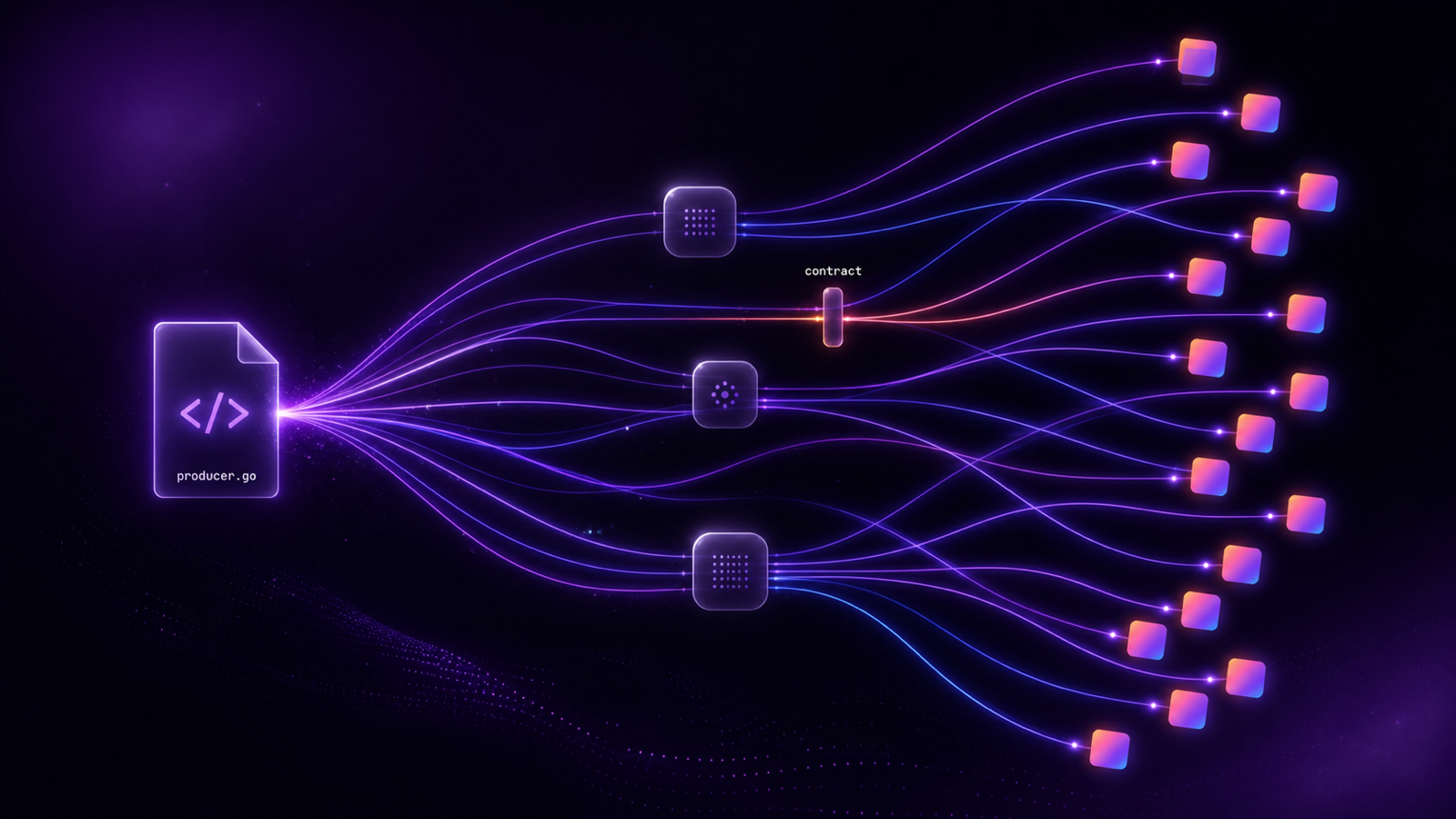
This is where data contracts come in. A data contract is a YAML file, checked into a central contract repository, owned by the producing team, and enforced in CI/CD. When a software engineer opens a PR that changes a schema or breaks a constraint the contract defines, the check fires before the change merges. The contract doesn't just describe what downstream consumers expect; it stops the producer from shipping a breaking change in the first place. For software engineers, that's what shifting left on data reliability actually looks like in the workflow they already use every day.
For software engineers ready to bring the same rigor to dataflows that they already bring to code, the next step is to see how Gable applies data contracts at the producer side, in CI/CD, before breaking changes reach downstream consumers. Sign up for free.

Gable
May 26, 2026

.avif)
.avif)