%20(1).avif)




Most advice on AI data readiness checks the wrong thing. The standard playbook treats readiness as a bar an organization clears once: run the assessment, score the data lake across a fixed set of dimensions, remediate the gaps, and declare the data AI-ready. That approach measures a snapshot. And a snapshot of something that changes every week tells you very little about whether your data is ready today.
Readiness isn't a state an organization reaches and holds. It's a property that data producers either maintain or erode every time application code changes upstream. A model that trained on clean, well-understood data last quarter is now consuming whatever a renamed field, a changed unit, or a dropped column sends it this morning. The audit said the data was ready. The pipeline moved on. That gap, between audited ready and still ready, is where AI initiatives quietly degrade, and it's the part the readiness-checklist genre tends to skip.
Getting AI data readiness right means understanding what the term actually covers, why it slips, and where it has to be defended. The sections below work through each.

What does AI data readiness actually mean?
AI data readiness describes whether data is fit for the specific AI use case it feeds, and whether it stays that way once that use case runs in production. The fit part matters more than it sounds. There's no general-purpose standard that makes data ready for AI in the abstract. As Gartner puts it, the readiness of data for AI depends on how the data will be used: the dataset that trains a predictive maintenance model looks nothing like the corpus behind a retrieval system, which looks nothing again like the event stream an autonomous agent acts on.
That has an awkward consequence for the checklist approach. High-quality data, judged by traditional standards, doesn't automatically equal AI-ready data. Analytics teams routinely cleanse data and strip outliers to match what human analysts expect. An algorithm often needs the opposite: representative data, including the messy and unusual cases, because those cases are part of what it has to learn. Data that's been polished for a dashboard can be actively wrong for a model.
So readiness is relative to a use case, not absolute. And because the use case runs continuously while the data feeding it keeps changing, readiness is also temporary. A readiness assessment can be entirely accurate the day it's run and false a week later, after one upstream change nobody flagged.
Why traditional data quality isn't the same as AI readiness
The distinction between conventional data quality and AI readiness comes down to who consumes the data and how forgiving they are. A human analyst reading a quarterly report notices when a number looks wrong, asks where it came from, and applies judgment. A model applies no judgment. It absorbs whatever it's fed and produces a confident output either way, which means small upstream defects don't announce themselves. They surface later as degraded predictions, skewed recommendations, or a training set quietly seeded with bad examples. The mechanics of how those defects originate are covered in more depth in Gable's work on data quality.
This raises the cost of the failures that traditional quality controls are weakest at catching. A dropped column doesn't throw an error. It sends nulls into a feature the model expected to be populated. A unit changed from dollars to cents doesn't break a pipeline. It scales an input by 100 and nobody notices until the output drifts. These are silent, structural changes, and they pass straight through the row-count-and-null-check style of monitoring that many quality programs rely on.
AI readiness also demands context that analytics quality measures don't always track: where the data came from, how it's been transformed, and whether it still represents the conditions the model was built for. That context lives in metadata and data lineage, which is why a model can pass every field-level quality check and still be unfit for use, because the data, while clean, no longer reflects reality.
The dimensions of AI-ready data
Most readiness frameworks converge on a similar set of dimensions, and they're worth knowing because they're the table stakes any AI data effort has to cover. Each one matters for a reason specific to AI, not just for general governance hygiene:
- Accessibility. A model can only act on data it can reach. Data fragmented across silos, lakes, and applications forces extra preparation work and leaves blind spots. According to IBM's Institute for Business Value, only 29% of technology leaders strongly agree their enterprise data meets the quality, accessibility, and security standards needed to scale generative AI.
- Quality and representativeness. Data has to be accurate where accuracy matters and representative of the conditions the model will face, which isn't the same as being scrubbed clean.
- Governance and compliance. Sensitive data feeding a model carries the same regulatory weight it does anywhere else, and AI use cases add new obligations around how that data is used and audited. The broader picture sits in data governance for AI.
- Context and lineage. Models need to know what data means and where it came from. Active metadata and lineage supply that context and make it possible to trace a bad output back to its source.
- Fitness for the use case. The dimension the others build toward: data that's appropriate for the particular model or system it serves, judged against that use case rather than a universal bar.
These dimensions describe what ready data looks like. They don't, on their own, explain why data that satisfied all of them stops satisfying them, which is the harder problem.
Why AI readiness keeps slipping

Readiness slips because the data feeding an AI system is produced by application code, and that code changes constantly. Every schema migration, every refactor, every new feature that touches an event payload is an opportunity to alter the shape or meaning of the data flowing downstream. None of those changes are made with the model in mind, because the engineer shipping them usually has no visibility into which models depend on the field they're editing.
This is why the breakage happens upstream, in the producing service, long before the data lake or the model that eventually consumes it. By the time a problem shows up in a model's output, it has already traveled through ingestion, storage, and transformation, picking up distance from its cause at every step. Tracing it back is the expensive part, and it's expensive precisely because the failure originated somewhere far from where it was noticed.
A point-in-time assessment can't hold up against this. A checklist scores the data as it exists on the day of the audit; the pipeline that produces that data changes on its own schedule, indifferent to when the last review happened. The result is a standing gap between the readiness an organization certified and the readiness it actually has right now. Re-running the assessment more often shrinks the gap but never closes it, because the assessment is always describing the past.
Keeping data AI-ready at the source
Closing that gap means moving the readiness check to where readiness actually breaks: the point where data is created. Instead of auditing data downstream after it has already flowed into the lake, a shift-left approach validates data against expectations in the application code, before a change ships. Catching a breaking change at the moment an engineer writes it is far cheaper than discovering it weeks later in a model's degraded output. Gable's overview of shift-left data tools lays out the category.
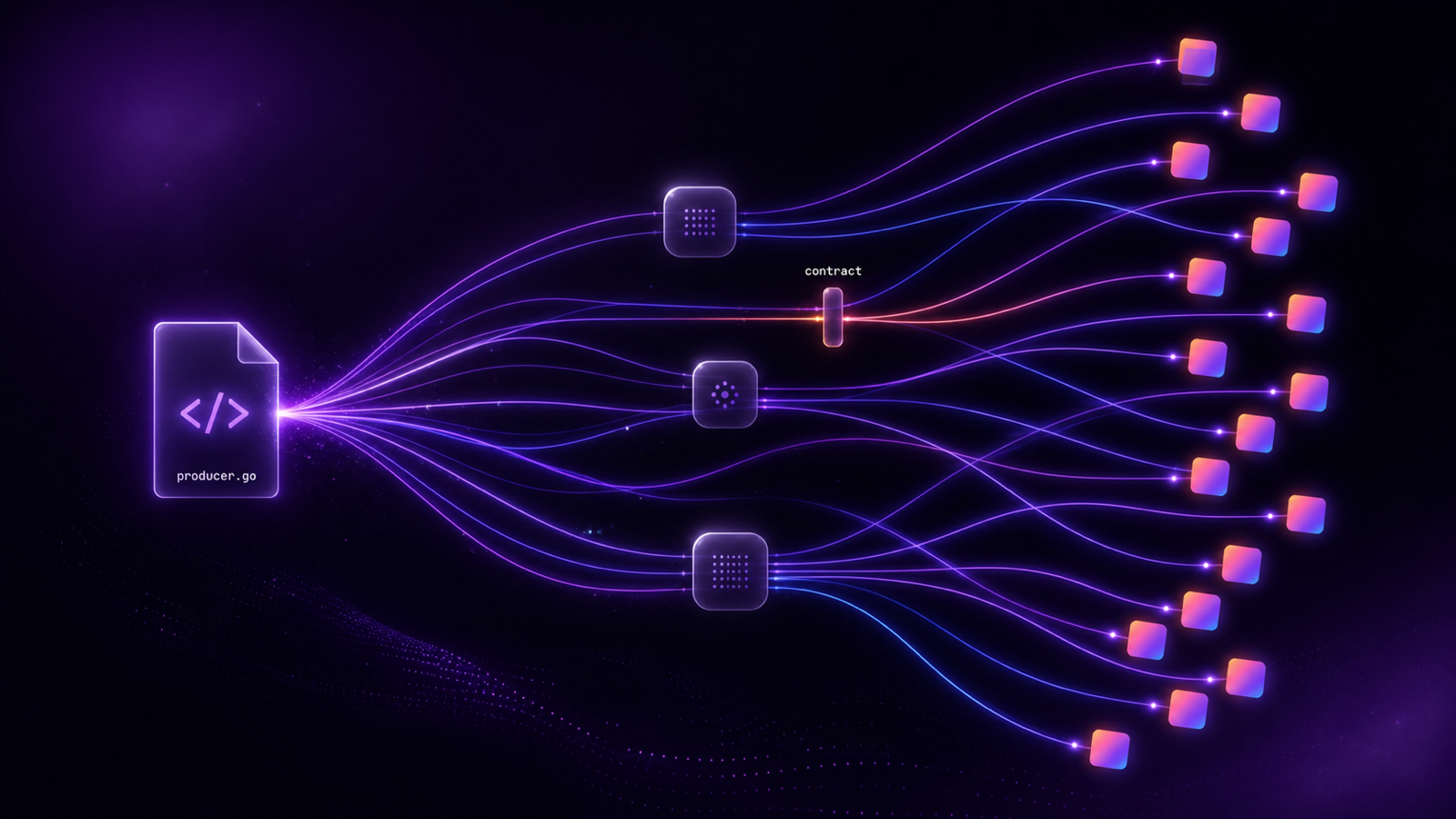
The mechanism that makes this work is the data contract. A data contract is an enforceable agreement between the data's producers and its consumers that defines the schema, the semantics, and the ownership of a dataset. Gable implements data contracts at the application code level and enforces them in CI/CD, so a change that would violate the contract, a dropped field a model depends on, a type change, a renamed field, gets caught in the pull request rather than in production. The data that reaches the model stays consistent with what the model was built to expect, change after change.
That's a different model of readiness from the periodic assessment. An assessment scores the data on a fixed cadence and hopes it holds between reviews. Contract enforcement checks every change as it happens, which turns readiness from a status an organization reports into a property the pipeline maintains continuously. The difference isn't a matter of rigor in the audit. It's the difference between describing readiness and enforcing it.
From readiness checklist to readiness by design
AI data readiness is real, and the dimensions the frameworks describe are worth meeting. But readiness defined as a checklist result will always lag the systems it's meant to describe, because the data those systems consume is produced by code that never stops changing. Readiness that lasts has to be built into how data is created and changed, not assessed after the fact.
That's the shift data contracts make possible: readiness maintained at the source, enforced on every change, rather than scored once and trusted until the next audit. For a fuller picture of why moving quality and ownership upstream changes what teams can rely on, Gable CEO and co-founder Chad Sanderson's Shift Left Data Manifesto is the place to start. Sign up with Gable to see what readiness by design looks like in practice.

Gable
July 2, 2026

.avif)
%20(1).avif)