.avif)



A software engineer renames a field in a service no one downstream knows they depend on. The column that fed a churn model as subscription_status becomes sub_state, and the values shift from a clean enum to free text. Nothing throws an error. The pipeline runs green. The model keeps scoring. Six weeks later, retention forecasts are quietly, confidently wrong, and the data team is reverse-engineering a problem whose cause is buried under everything that's happened since.

That's the shape of almost every AI data quality failure. The model didn't break. The pipeline didn't fail. The data did, and it failed silently, far upstream of where anyone was looking.
The cost is well documented. Poor data quality is the most frequently cited reason AI initiatives stall. Gartner predicts that through 2026, organizations will abandon 60% of AI projects that aren't supported by AI-ready data, according to Gartner's own analysis. Informatica's 2025 CDO Insights survey found that data quality and readiness rank as the top obstacle to AI success, named by 43% of organizations. The model architecture is rarely the thing that fails. The data feeding it is.
AI raises the stakes on a problem data teams already know well. Models consume data far downstream of where it's created, and the traditional fixes (monitoring dashboards, cleansing jobs, validation suites) all operate after the data already exists. They catch symptoms. They don't catch the upstream change that caused the problem.
What AI data quality means
AI data quality is the degree to which data is accurate, complete, consistent, and fit for use across the AI lifecycle, from training through validation to production inference. It builds on the same foundations as traditional data quality, and the core dimensions still apply:
- Accuracy: the data correctly represents the real-world value it's meant to capture.
- Completeness: expected values are present, not missing or null where the model assumes signal.
- Consistency: the same entity is represented the same way across sources and over time.
- Timeliness: the data is current enough for the decision the model is making.
AI introduces dimensions that traditional analytics underweight. Because a model learns patterns rather than reading rows, the shape of the data matters as much as the individual values. IBM's framing of AI data quality highlights factors that don't appear on a standard data quality scorecard:
- Representativeness: the training data reflects the population the model will actually see in production.
- Label accuracy: the ground-truth labels a supervised model learns from are correct, not noisy or inconsistent.
- Bias: the data doesn't systematically over- or under-represent groups in ways that skew model behavior.
- Noise: irrelevant variation doesn't drown out the signal the model needs to generalize.
These dimensions are harder to inspect than a null check. A dataset can be 100% complete and still be unrepresentative, mislabeled, or biased. That's the first reason AI data quality resists the tooling most teams already own.
Why AI makes data quality harder than traditional analytics
A broken dashboard announces itself. A number looks wrong, a stakeholder asks about it, someone traces the query. AI systems remove that feedback. A model trained on subtly corrupted data doesn't error. It produces outputs that are mathematically valid and business-meaningless, and it produces them with total confidence.
Failure is silent
Garbage in, garbage out is the oldest rule in data, but with AI the garbage is invisible. Traditional pipelines fail loudly when a job crashes or a schema mismatch halts a load. A model absorbs the bad input and keeps going. The degradation shows up as slightly worse predictions, a drift in a metric, a recommendation that's a little off, none of which trips an alert designed to catch outages.
The feedback loop is long
By the time a degraded model surfaces in production, the change that caused it happened weeks earlier and is buried under every other change since. Diagnosing it means working backward through training runs, feature pipelines, and source systems to find the one upstream edit that moved the data. Teams end up spending a large share of their week reactively tracing and fixing data quality problems, time spent firefighting rather than building.

Agentic systems compound it
Training data is a snapshot you can at least audit before a run. AI agents consume live data as input and act on it in real time, so an upstream change corrupts decisions the moment it ships, not at the next training cycle. The window between a bad change and its downstream damage collapses to zero, which makes prevention at the source the most reliable control.
The root cause: data quality fails upstream, not downstream
Every dimension above traces back to a single structural fact. The data an AI system consumes is produced somewhere else, by someone else, usually a software engineer shipping a code change to an application or service. That producer has no visibility into how the data is used downstream. To them, renaming a field or changing a type is a routine, reasonable refactor. To the model three systems away, it's a breaking change that silently invalidates an assumption the training set depended on.
This is why data anomalies are so hard to predict and resolve: the technical trigger and the downstream damage live in different systems owned by different teams. Schema changes, semantic drift, and broken assumptions cause more damage than the kind of random bad values that validation rules are built to catch. The problem isn't dirty data sitting in a warehouse. The problem is change, introduced upstream, with no mechanism to catch it before it propagates.
Most tooling meets this problem too late. Data monitoring and observability platforms watch data after it's produced, evaluating freshness, volume, and distribution shifts as it moves through pipelines. That's useful for detecting that something changed. It's reactive by design. Monitoring explains what went wrong after the fact; it doesn't prevent the change, and it often can't tell you whether a shift was an expected business event or a violated assumption. Cleansing and data quality management routines have the same limitation: they treat the symptom downstream, after the bad data has already reached the model.
Moving from detection to prevention
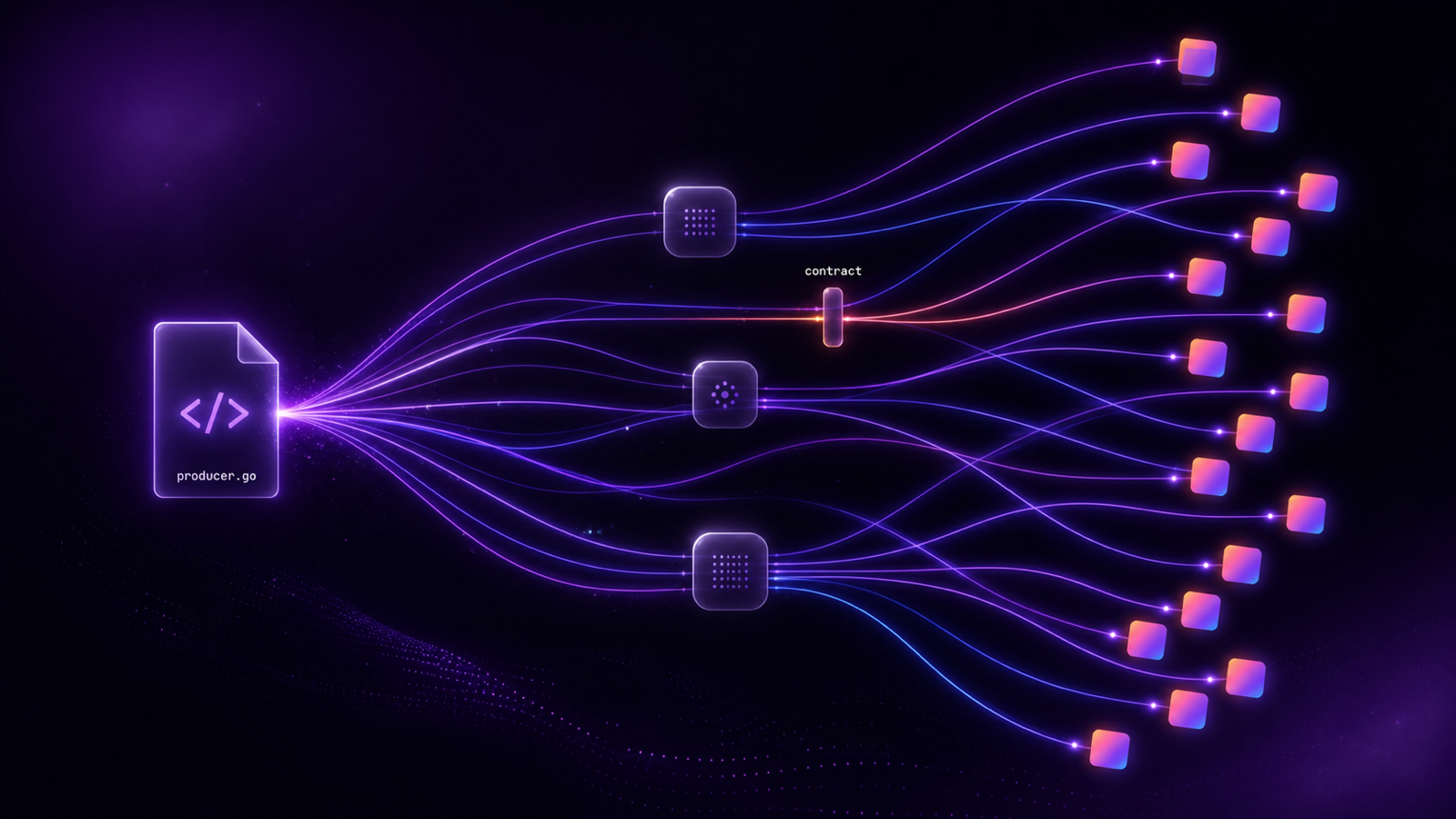
Preventing bad AI data means catching the breaking change where it originates, in the producer's workflow, before it ships. That requires agreement on what a data asset is supposed to look like (its schema, semantics, constraints, and ownership) and enforcement of that agreement at the point of change rather than the point of consumption.
This is the role data contracts play. A data contract is an explicit agreement between the producers and consumers of a data asset that defines its expected shape and assigns accountability for quality to the producer. When a producer introduces a change that would violate the contract, the check runs in the CI/CD pipeline and flags the breaking change at the pull request, before it merges, before it reaches the model. The renamed field that would have silently corrupted a training set becomes a failed check the engineer sees while they're still in the code.
That shift in timing is the whole point. Moving quality enforcement to the first mile of the data supply chain (the moment data is created or changed) is what shift-left data thinking means in practice. It reframes data quality from a downstream cleanup burden into an upstream engineering discipline, and it puts the control where the change actually happens.
Treating each dataset as a product with an owner, an interface, and a contract reinforces the same principle. When teams adopt data as a product thinking, the producer is accountable for the data they emit the way any engineer is accountable for an API they publish. For AI systems specifically, this is also the foundation that effective data governance for AI builds on, since you can't govern training data you can't trust at the source.
Building AI systems on data you can trust
AI quality is a data quality problem, and data quality is an upstream change-management problem. The models that fail in production rarely fail because the architecture was wrong. They fail because a change made far upstream, by someone with no view into the consequences, quietly broke an assumption the system depended on, and nothing caught it until the damage was done. Monitoring and cleansing will always have a place, but they operate after the fact. The leverage is at the source.
Gable puts that leverage where it belongs. By defining data contracts between producers and consumers and enforcing them in CI/CD, Gable catches backwards-incompatible changes at the pull request, so bad data never reaches the model that would have learned from it. Producers own the quality of what they emit, and AI systems consume data that's accountable by design.
For data leaders ready to build AI on a foundation they can trust, the place to start is the thinking behind the approach. Read the Shift Left Data Manifesto by Gable CEO and co-founder Chad Sanderson for the principles and practical shifts that make upstream data quality real, then sign up for Gable to put data contracts to work in your own pipelines.

Gable
July 2, 2026

.avif)
.avif)