%20(1).avif)



Modern systems use code to define far more than runtime behavior. Developers embed schemas, events, and contracts directly in source code, shaping how teams structure, exchange, and interpret data. These definitions determine compatibility and meaning long before consumers interact with the system. Yet most teams invest heavily in cataloging datasets and tables downstream while the code that defines those assets upstream lacks equivalent visibility, structure, and governance.
In large systems, such as Java-based enterprise data platforms, this context spans repositories and teams, with no shared index for code ownership or lineage. When schemas change or APIs evolve, engineers must rely on personal experience or manual code review to determine which systems or consumers the changes affect. This approach does not scale, and it predictably breaks down as systems become more distributed, event-driven, and shared across organizations.
This is where code cataloging comes in.
What is code cataloging?
Code cataloging is the process of treating code-level definitions as first-class assets. Instead of leaving schemas, APIs, and events buried in repositories, a code catalog inventories them with ownership, lineage, and lifecycle context—making them discoverable, governable, and usable across teams.
In practice, this means surfacing the structures defined in source code and connecting them to the roles responsible for them. Teams gain visibility into what each definition represents, where developers use it, and how much stability downstream services or consumers can expect. This allows engineers to assess impact before changes ship, not after systems break.
Why code needs a catalog
Code needs a catalog for the same reason data does: scaling breaks informal coordination and creates chaos. As systems grow across teams, repositories, and services, understanding what a piece of code means, who owns it, and what it affects becomes just as important as understanding how it runs.
Here's how a code catalog can help your teams regain control as systems scale:
Code changes lack clear ownership
In most production systems, authoritative definitions of schemas, events, and interfaces live in code. Java classes, for example, define payload structures, annotation constraints, API interfaces, and serialization logic that shape downstream data, integrations, and analytics long before your services process them.

When this information exists only as source files, it remains effectively invisible outside the team that owns it. Without a shared view of what a schema represents, how stable it is, or how developers expect it to evolve, upstream changes can create unexpected downstream effects.
A code catalog addresses this by making definitions explicit, discoverable, and inspectable across the organization. Instead of relying on individual knowledge, teams gain clarity around ownership, stability expectations, and change responsibility—turning schema evolution into a safe and predictable process.
Change impact is difficult to predict
Many data and integration failures in production stem from code changes made without a clear understanding of which systems or users depend on them.
Without code-level lineage, engineers must infer impact manually: searching repositories, scanning commit history, or relying on personal knowledge. This slows feature delivery, increases security risk, and turns routine changes into high-stakes decisions.
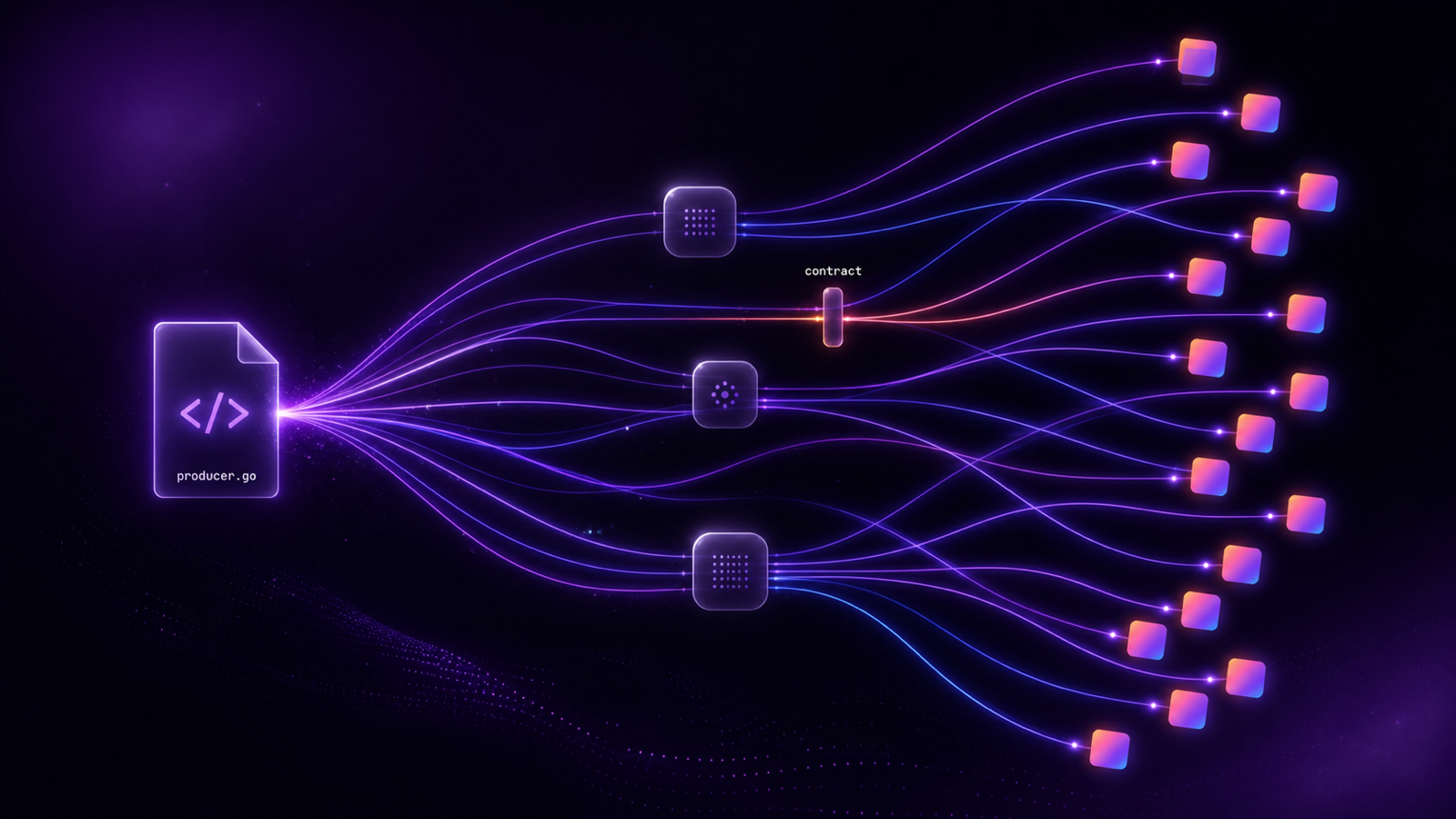
A code catalog provides artifact-level data lineage, enabling teams to assess the blast radius or change impact before shipping updates.
Governance breaks when scaled without clear ownership
Governance frameworks built around repositories alone don't survive scale. As services multiply and teams turn over, decisions about who reviews a change, which interfaces are stable enough to depend on, and which artifacts are deprecated stop being a function of policy and become a function of tribal knowledge. The result: inconsistent reviews, untracked breaking changes, and accountability that evaporates the moment the original author leaves the team.
Code repositories do not encode ownership in a scalable way. For example, Git history simply shows who last touched a file, not who is responsible for its evolution or downstream impact. As systems expand, this lack of visibility leads to unclear review ownership, inconsistent change approval, and delayed impact analysis during incidents—especially when changes span multiple services or teams.
A code catalog introduces structure where repositories cannot. By attaching lifecycle state, accountability, and stability expectations directly to code artifacts, teams can route changes to the right reviewers, enforce compatibility standards, and make evolution predictable. This transforms ad hoc coordination into a repeatable change model that preserves development velocity.
Why code cataloging becomes inevitable at scale
Code cataloging becomes essential when systems reach a certain scale. Expanding architecture, distributed ownership models, and AI-assisted development all push code beyond the limits of informal coordination and repository-level tooling. At this point, the problem isn't about code quality vs. data quality—it's about missing structure around meaning, ownership, and change.
This breakdown shows up in three ways:
- Source code becomes the record for data and interfaces
- Scaling breaks informal ownership models
- AI-assisted code increases change velocity without proper context
The following sections examine how these forces play out in practice and why code catalogs are critical infrastructure for managing them.
The source of truth lives in code
Definitions governing structure, compatibility, and data exchange live directly in source code. Languages like Java make this especially explicit, with developers defining data structures through POJOs, validation rules through annotations, serialization behavior through libraries like Jackson, and integration contracts through interfaces.
In event-driven architectures, these definitions often serve as the canonical source of truth for downstream consumers like Kafka topics, streams, APIs, and analytics pipelines. As systems grow, the same logical concept may exist across multiple services and evolve independently.

A code catalog shows where each definition is used, how stable it is, and which systems it affects so teams can anticipate change impact before it reaches production.
Scaling breaks informal code ownership
In small systems, engineers can infer ownership because they know who maintains what, how the team routes reviews, and how they coordinate changes. At scale, that model collapses. Microservices multiply, repositories fragment, and teams change faster than documentation can keep up.
Without explicit code ownership and automated lineage, developers struggle to answer basic questions like: "Who owns this schema?" and "Who should review this API change?" Code catalogs encode this information directly at the artifact level, which enables consistent review paths, clearer accountability, and faster impact analysis—without adding manual processes.
AI coding increases change velocity without context
AI-assisted development dramatically increases the volume and speed of code changes. LLMs generate DTOs, schemas, APIs, and validation logic in seconds, while bots and agents open pull requests, refactor code, and modify interfaces.
However, AI does not provide shared context: ownership, intent, stability expectations, or downstream impact. As non-human authors become common, traditional signals like Git history become less meaningful. Code catalogs provide the missing layer by tracking AI-generated code, its evolution, accountability, and propagation of changes. In AI-driven environments, code cataloging helps teams scale velocity without sacrificing control.
Code cataloging vs. data cataloging
Code cataloging and data cataloging solve related but fundamentally different problems. Both are essential, yet they operate at distinct layers of the system and answer separate questions about trust, ownership, and change.
Here’s how code cataloging differs from data cataloging:
Data catalogs observe data after its creation
Data catalogs focus on data assets that already exist in production systems, such as tables, streams, dashboards, and derived datasets. They help teams understand where data originates, who owns it, and how downstream users or services consume it. In this context, lineage is observational because it reconstructs relationships based on how data flows after APIs or services create it.

This makes data catalogs valuable for analytics, governance, and compliance. However, since they surface issues only after code changes have already propagated, data catalogs merely explain what happened rather than preventing it. By the time a schema breaks or semantics shift, the original intent—and the code that introduced the change—may already have evolved with the application.
Code catalogs govern definitions before they break things
Code catalogs operate upstream, capturing the artifacts that define structure and meaning. Schemas, APIs, events, and contracts become explicit, traceable, and linked to ownership, lifecycle state, compatibility expectations, and change history.
By making these definitions observable at the source, code catalogs allow software teams to anticipate impact before merging changes. This practice supports proactive governance, routing reviews to the right owners, enforcing stability guarantees, and ensuring data contracts remain valid as systems evolve.
In essence, code cataloging complements data cataloging by closing the gap between definition and execution.
What code catalogs enable for software teams
A code catalog is not an abstract governance concept. It's a tool that unlocks capabilities that are hard to implement reliably without a structured metadata layer. By inventorying code artifacts with ownership, lineage, and lifecycle context, developers can move from reactive coordination to proactive control.
Here's what modern teams really get from code catalogs:
Code-level lineage and change impact analysis
Without a code catalog, impact analysis is largely manual. Engineers typically search repositories, grep for patterns, or rely on individual knowledge to infer which services consume a schema, event, or API. In distributed systems, this approach is slow, error-prone, and insufficient.
A code catalog provides artifact-level lineage, making explicit which services produce a schema, which consumers depend on it, and how those relationships evolve over time. With this visibility, teams can assess change impact before pushing code to production—determining affected consumers, compatibility guarantees, and appropriate review paths early in the development cycle.
Contract readiness and enforceable change boundaries
Most systems rely on implicit contract testing. APIs, events, and schemas behave as if contracts exist, but expectations around stability, compatibility, and ownership are rarely formalized.
Code catalogs make these assumptions explicit. By attaching lifecycle state (experimental, stable, deprecated), ownership, and compatibility expectations directly to code artifacts, teams can distinguish between changes that are safe by design and those that require coordination.
This approach makes contract enforcement practical rather than aspirational. Developers can route reviews to the right owners, validate contracts pre-merge, and evolve interfaces intentionally—so contracts become living constraints enforced in code rather than static documents or downstream checks.
Shared visibility across engineering and data teams
Misalignment around ownership and intent is a persistent source of friction between engineering and data teams. Engineers focus on code, while data teams focus on datasets. When issues arise, neither side has a complete view of where definitions originate in code and how they propagate downstream.
Code catalogs surface schemas, events, and interfaces upstream, aligning data consumers with the code-level definitions that shape their assets. This reduces ambiguity during incidents, shortens feedback loops, and replaces guesswork with shared context.
Moreover, this visibility doesn't require data teams to read code or engineers to manage downstream metadata manually. Instead, the catalog bridges the gap by exposing code semantics in a structured, accessible way—allowing both groups to reason about change using the same source of truth.
Gable's approach to code changes and governance at scale
As systems grow in size and complexity, code governance can no longer remain a downstream concern. Engineers define schemas, APIs, events, and contracts in source code, yet most teams apply structure and visibility only after those definitions propagate—leading to broken integrations, unclear ownership, and late-stage surprises. Shifting governance left, into the code itself, is the only sustainable way to manage change at scale.
Code cataloging fills that missing layer. By making definitions visible, traceable, and owned, teams can assess impact, enforce stability, and coordinate evolution before changes ship. This transforms fast iteration from a gamble into a controlled, predictable process.
Gable makes this practical by automatically extracting and managing code metadata directly from development workflows, giving engineering teams a clear system of record for ownership, lineage, and change.
See Gable in action: Sign up for a demo to discover how code–level metadata infrastructure enables proactive governance and streamlined code cataloging.

Gable
May 7, 2026

.avif)
.avif)