%20(1).avif)



An AI data pipeline exists to keep a model's understanding of the world accurate as that world keeps changing. A trained model is a snapshot of patterns that held true at the moment its training data was assembled, and those patterns drift the instant real conditions move on from them. The pipeline is the machinery that keeps the snapshot current, continuously feeding the model fresh, prepared data so its predictions reflect how things actually are rather than how they used to be. Everything an organization trusts a model to do, from forecasting demand to flagging fraud, rests on that loop doing its job quietly and correctly.

That dependence is also the source of the risk. When the data flowing through the loop is sound, the model stays calibrated and the people relying on it never have to think about the plumbing underneath. When the data is quietly wrong, the same loop that keeps a model current will just as faithfully teach it something false, and it will keep doing so on every retraining cycle until someone notices the outputs no longer make sense. Understanding what an AI data pipeline is, how it differs from the pipelines engineers already know, and where it tends to fail is the foundation for building one that earns the trust placed in it.
What is an AI data pipeline?
An AI data pipeline is an automated system that ingests, transforms, and continuously delivers data for training and running machine learning models. It pulls raw data from many sources, shapes that data into a form a model can learn from, feeds it into training and inference, and watches how the resulting model behaves over time. The defining difference from a conventional pipeline isn't the steps themselves but the output. A traditional pipeline's product is a report or dashboard a person reads and interprets. An AI pipeline's product is a model that consumes the data directly, makes predictions from it, and feeds production systems, applications, and increasingly autonomous agents.
Several distinct artifacts move through the pipeline, and each handoff between them is a boundary where one team's output becomes another team's input. Raw data collected by engineers becomes the curated datasets that analytics teams depend on, which become the feature sets that machine learning engineers train against, which become the model artifacts that get deployed and monitored. Every one of those handoffs is a point where expectations between a producer and a consumer have to hold, and where data quality is either preserved or silently lost.
AI data pipeline vs. traditional data pipeline
Both kinds of pipeline move data from one place to another and transform it along the way, so engineers often assume an AI pipeline is a conventional one with a model bolted onto the end. The more useful distinction is rhythm. A traditional pipeline runs in a line: extract data from a source, transform it according to business rules, load it into a warehouse, and serve it to a dashboard. The flow has a clear start and end, and it runs again on the next schedule.
An AI pipeline loops. Data trains a model, the model makes predictions, the outcomes of those predictions become signals that feed the next round of training, and the cycle repeats. That loop is what lets a model improve and stay current, but it also changes the stakes of an error. In a linear pipeline, a bad transformation produces one wrong report that a person can usually spot and correct. In a looping pipeline, a bad input gets absorbed into a model's learned behavior and compounds quietly across retraining cycles, shaping thousands of downstream predictions before anyone traces the problem back to its origin.
None of this makes the extract, transform, and load skills obsolete. An AI pipeline extends the data pipeline process engineers already run rather than replacing it. The familiar stages still anchor the work, with new stages and a feedback loop built around them.
The core stages of an AI data pipeline
Most AI pipelines share five stages. The first two will feel familiar to anyone who has built conventional pipelines. The rest are where AI workloads diverge.
Ingestion
Ingestion pulls data from its sources: relational databases, event streams, application logs, third-party APIs, and unstructured stores of text and images. AI workloads raise the bar on freshness, since a model serving live inference needs data in seconds rather than overnight, so AI pipelines lean harder on streaming ingestion than batch-oriented analytics pipelines typically do.
Transformation and feature engineering
Transformation cleans and normalizes the raw data, and feature engineering turns it into the specific inputs a model learns from. This is the stage that has no real equivalent in a reporting pipeline. A dashboard consumes columns more or less as they arrive, while a model consumes engineered features whose definitions have to stay identical between training and live serving. When those definitions drift apart, the model degrades without any obvious error.

Training and inference
Training builds the model from prepared features, and inference runs the finished model against new data to produce predictions. A failure mode specific to this stage is training-serving skew, where the data a model sees in production differs subtly from the data it trained on. The model still returns answers, and the answers still look reasonable, which is exactly what makes the skew hard to catch.
Monitoring
Monitoring tracks how the deployed model performs and watches for data drift, the gradual divergence between current data and the patterns the model learned. Most pipeline tooling concentrates here, at the end of the loop, which is sensible for catching gradual decay. It's less effective against the failure that does the most damage, which arrives suddenly and from upstream.
Where AI data pipelines break, and why it's hard to see
The most damaging failures in an AI pipeline usually start as small, ordinary changes in the code that produces the data. A software engineer renames a field, changes a column's type, or stops emitting a value that a downstream model quietly depends on. Nothing in the producer's world looks broken, the application ships, and the change propagates into the pipeline. This is the same inversion of responsibility that schema-on-read approaches introduced, where validation happens when data is read rather than when it's written, long after the producer has moved on.
In an analytics pipeline, that kind of change tends to produce a visibly broken report, and someone notices the number is wrong. In an AI pipeline, the loop absorbs the change instead. A model retrains on the altered data, learns the wrong pattern, and keeps producing confident, plausible, incorrect predictions. The outputs don't throw errors. They just drift away from reality while every dashboard about the pipeline's health stays green.
The structural problem is one of placement. The failure originates in producer code, but the pipeline's quality checks live downstream, in staging environments and monitoring layers that only see the data after the model has already consumed it. Anomaly detection and drift monitoring catch the symptom once it surfaces. By then the bad data has been learned, the retraining cycle has run, and tracing the degraded predictions back to a single upstream commit is slow and expensive work.
Building reliable AI data pipelines: catching failure at the source
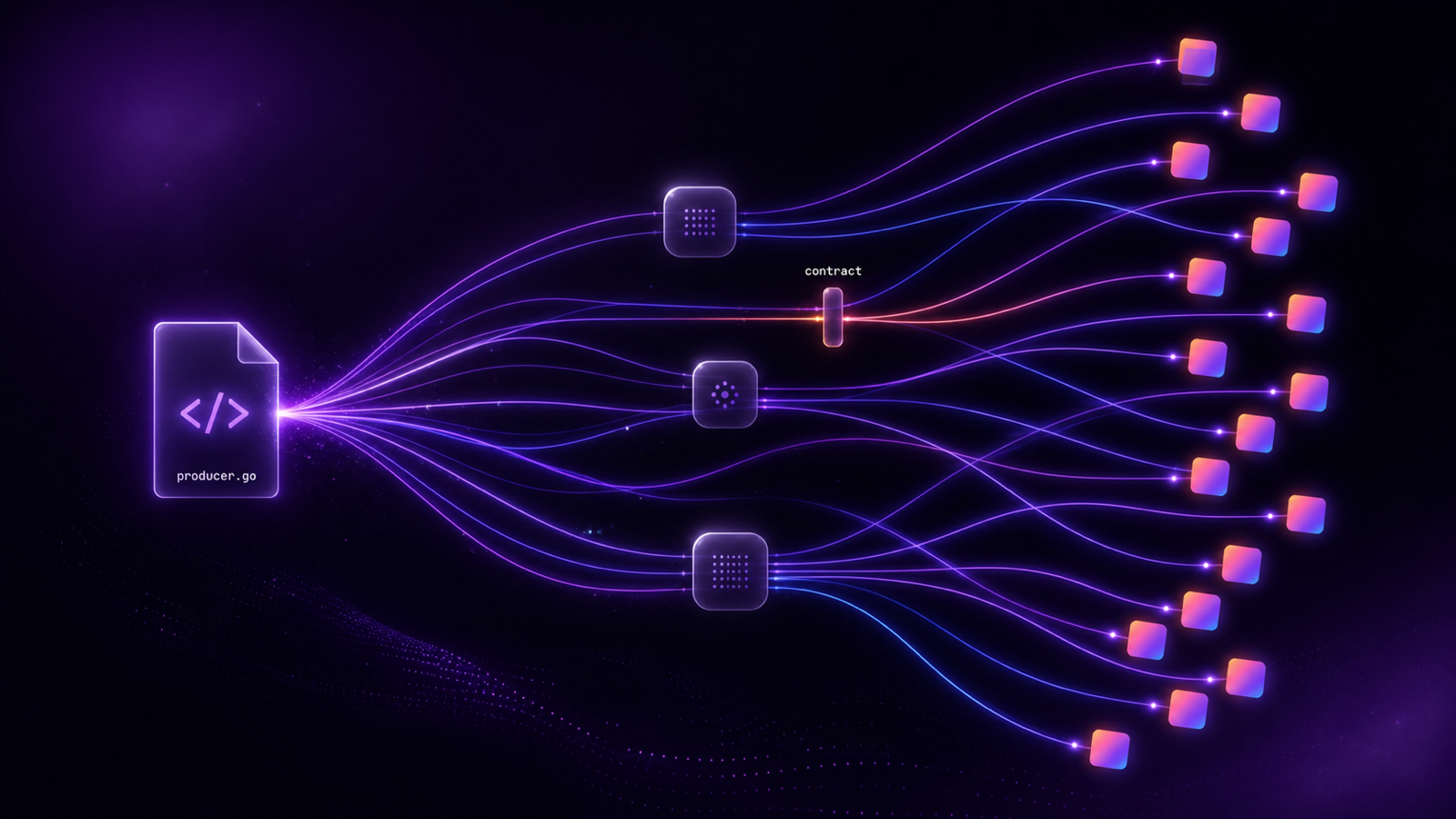
If the failure starts in producer code, the checks belong in producer code too. Shifting left means moving data validation to the point where data is created, so a breaking change gets caught as it's written rather than diagnosed after a model has absorbed it. The mechanism that makes this enforceable is the data contract.
A data contract is an enforceable agreement between a data producer and its consumers that defines the schema, semantics, and ownership of the data passing between them. It turns the implicit expectations at every handoff in the pipeline into explicit rules that a system can check automatically. When a change would violate those rules, the contract fails the change instead of letting it flow downstream.
Gable applies this directly in the engineer's workflow. Gable implements data contracts at the application code level and validates them inside CI/CD using static analysis, surfacing breaking structural changes like renamed fields, type changes, and dropped fields before code merges or deploys. It also provides code-level lineage that maps how data fields propagate across services and pipelines, so an engineer can see which models and downstream consumers a given field feeds before changing it. Gable sits among other shift-left data tools, and its distinction is enforcing those schema and semantic constraints at the source rather than validating data after it already exists.
For the engineer, the practical change is where the work happens. Instead of being pulled into an incident days later to trace a degraded model back through the pipeline, the engineer sees the problem at the pull request, in the same review where the code change lives. That means fewer on-call escalations and less rework, and it keeps data reliability inside normal software development instead of treating it as a downstream cleanup job.
Keeping the loop honest
An AI data pipeline's feedback loop is what makes a model valuable and what makes upstream failure uniquely costly. The same cycle that keeps a model current will propagate a silent error just as efficiently, compounding it across every retraining until trust in the model's output erodes. Catching that error after the model has learned from it is always a step behind the problem. Enforcing data contracts in code stops breaking changes at the source, before they ever reach the loop, which keeps the model learning from data that reflects reality and keeps engineers out of incidents that never had to happen.
For a deeper look at moving quality, ownership, and governance upstream, read the Shift Left Data Manifesto by Gable CEO and co-founder Chad Sanderson, or sign up for Gable to see how data contracts catch breaking changes at the source.

Gable
June 26, 2026

.avif)
.avif)