.avif)




Large language models (LLMs) have revolutionized how enterprises deliver business value. Since they can generate human-like text very quickly, many companies today use AI chatbots to supplement their existing support and user experience initiatives.
But as AI’s capabilities grow, so do concerns about the vast amounts of data it processes, particularly about LLM data privacy. Because these models consume large training data, which often includes sensitive personal information, companies are grappling with unintentional data leaks, potential misuse, and increased regulatory pressure, among other risks. These inevitably lead business leaders to wonder how they can make AI models both powerful and privacy-conscious without sacrificing performance or security.
In this ever-evolving AI security landscape, ensuring data privacy requires more than complying with regulations like GDPR and HIPAA. You also need to implement effective safeguards within development workflows to keep your AI models safe, even in the hands of unruly users. Additionally, your developers must strike a balance between building powerful AI models and managing the risks they pose for sensitive user or business data.
Read on to find out more about the real-world data privacy challenges of modern AI models and LLMs and learn how to minimize risks and protect LLM data without compromising model performance.

Why LLMs amplify PII risk for SWEs
LLMs bring unique risks when they have access to personally identifiable information (PII). That’s because sensitive data can inadvertently slip through when developers change training datasets and model parameters. Generative AI tools, like chatbots, further heighten LLM data privacy risks because they can generate text that unintentionally exposes PII.
These risks are why developers need to adopt privacy-focused practices from the beginning. Doing so is what will keep your AI models secure and compliant.
LLMs increase PII risk for software engineers due to the following factors:
- Large-scale data collection: AI teams usually train modern LLMs on vast datasets, which data teams often scrape from the public Internet. But if this training data includes PII, like names or emails, and developers fail to scrub and mask them properly, the model could unintentionally store and output this sensitive information in its responses.
- Lack of data segregation: Unlike relational databases, which enforce strict schemas and access controls, LLMs treat all data (such as system instructions, user input, external context, and internal knowledge) as a continuous stream of tokens. This lack of schematic structure and trust boundaries makes it difficult to distinguish PII data in large AI training datasets.
- Overfitting AI models: PII and data compliance risks often increase when engineers fine-tune the model, which involves repeatedly exposing AI systems to smaller, highly sensitive proprietary datasets, such as internal customer service logs. This repetition can lead to severe model overfitting that makes LLMs highly biased toward those data points.
- Insufficient input validation: Overlooking LLM input validation is a major issue that causes your AI model to expose sensitive information. For instance, if engineers omit user input validation or sanitization, attackers can force your model to output sensitive data from its training tokens. A common method that attackers use to exploit this oversight is by embedding their own PII snippets into AI inputs and asking the model to construct similar snippets from its training information.
- Lack of model transparency and traceability: Enterprise LLMs often lack transparency into how specific data points affect model outputs since engineers don’t always have direct access to sensitive training data. This lack of visibility into the LLM’s data pipeline and its impact on the model’s responses prevents software engineers from reliably confirming whether the model embeds PII in its output.
- Complex integrations: Modern AI-powered solutions integrate AI chatbots into complex data systems like retrieval-augmented generation platforms, which interact with external databases and tools via APIs. If attackers compromise these external data sources or if these systems transmit data insecurely, they can lead to PII exposure.
Because PII exposure via LLMs is a complex issue, it requires careful attention from AI teams to prevent, especially as your models evolve to handle large amounts of data. As a result, understanding the specific attack vectors hackers use to compromise LLM data privacy is critical, as it enables engineers to implement effective data privacy safeguards directly into their development workflows.
LLM attack vectors
To fully understand LLM data privacy risks, it’s important to recognize the various attack vectors that can compromise your model’s integrity. Below are some of the most significant threats to modern AI models:
Data leakage
LLMs can leak sensitive information in their model outputs, typically when your training dataset is very large, unfiltered, or doesn’t provide engineers with full visibility. Even if your team uses effective data quality tools for cleaning training data, your AI model may learn specific patterns that reveal confidential information.
Example: A healthcare chatbot with access to patients’ medical records may generate accurate results for user queries. However, it may also include specific patient details if developers fail to implement differential privacy techniques to mask sensitive data. This risk increases when you use AI chatbots because your models can memorize high-frequency data points, like frequently mentioned names or addresses, especially during fine-tuning. As a result, unsanitized prompts or malicious inputs can trigger the model to disclose this data.
Prompt injections
In these attacks, attackers manipulate an LLM’s input to force the model to reveal sensitive data, bypass filters, or execute unintended actions. These injections can range from simple, malicious phrases to more complex, embedded code that tricks the model into exposing confidential information.
Example: Threat actors who try to bypass your AI model’s data protection restrictions often embed the sensitive part of their prompt within a series of normal inquiries to trick the model into revealing deep-nested information that it might have seen in training. As a result, these injections can cause AI models to generate sensitive content beyond their intended boundaries.
Membership inference
LLM attackers sometimes use membership inference to determine whether your developers included a specific data point in the training dataset. In practice, these attacks work by repeatedly querying the model with variations of user-specific data and analyzing its responses to identify patterns that are indicative of sensitive data from the training set. Overfitted AI models are particularly at risk here since they tend to respond more confidently about specific data points that they saw in training.
Example: If your LLM consistently responds with high confidence when users query about a certain set of data points, an attacker may infer that those points were part of the training data. They can then use that information to craft more advanced queries that include additional attack vectors, like prompt injections, to exfiltrate more sensitive information.

Data poisoning
Data poisoning in LLMs occurs when attackers intentionally introduce malicious or misleading data into the training set to alter the model’s behavior or introduce vulnerabilities that compromise its privacy. In successful data poisoning, attackers usually target the data supply chain well before your LLM reaches production. They do this by infiltrating public Internet scrapes and open-source datasets or by compromising internal data repositories via insider threats or network breaches. The goal is to embed vulnerabilities into the model’s weights during training.
Then, once developers train the model, malicious data corrupts the LLM’s behavior, leading it to incorporate corrupted logic as if it were part of the normal training logic. This can lead the model to associate a secret trigger phrase with malicious actions, such as bypassing safety filters or revealing PII.
Example: Imagine that attackers successfully plant malicious data in your AI data repositories by linking a standard phrase like “What’s the latest report?” to confidential information like employee salaries or upcoming projects. When your model encounters this phrase in a prompt, it will unintentionally expose company secrets.
How to prevent data privacy issues with LLMs
Since LLM data privacy challenges directly impact compliance and user trust, your developers need to balance the power of their AI models with the responsibility to protect consumer information.
Here are five practical techniques that software engineers can use to mitigate risks and improve privacy protections for their latest LLM models while still optimizing for accuracy and performance:
1. Differential privacy and data masking
Differential privacy techniques introduce noise into the model’s learning process, which prevents it from memorizing sensitive information. By introducing noise during training, engineers can confirm that specific data points, like names or addresses, aren’t easily identifiable from model outputs.
Data masking is another effective way to protect sensitive information during training. This method involves anonymizing data by tokenizing identifiers before you feed them to the model. That way, even if your model learns patterns, it can’t tie them back to specific individuals during runtime.
2. Data minimization
If your LLM doesn’t need to learn detailed information on a subject, you shouldn’t allow developers to use it in training. That’s what data minimization is—it limits the amount of sensitive data that your team uses in training. By minimizing the data surface, you can reduce the risk of information exposure.
Developers should instead use techniques like feature selection to identify the most relevant data for training while excluding irrelevant information. Although limiting training data this way may compromise your model’s performance, it helps you mitigate LLM data privacy risks while maintaining focus on your model’s key features.
3. Data provenance and lineage
To protect your LLMs from data poisoning, establish a robust data-provenance and lineage-tracking system. This practice allows your team to trace all training data’s origins and identify any compromised or malicious data that attackers might have introduced to the system.
By integrating version control and automated lineage tracking into the CI/CD pipeline, developers can review and audit changes to training data. And in the event of a data pipeline compromise, they can roll back to a safe version of the dataset instantly. Although this process increases LLM workflow complexity and deployment overhead, it’s crucial for maintaining the integrity of LLM training data and preventing unintentional data manipulation.
4. Federated learning
Federated learning allows your team to train LLMs across decentralized devices without centralizing sensitive data. In other words, engineers can train models locally on devices that contain the sensitive data and share only model updates to a global system that aggregates the model’s weight updates. This means sensitive data will never leave the source device or data repository.

However, while federated learning is effective for minimizing data leakage and privacy violations, it also introduces additional challenges in synchronizing model updates and establishing consistency across devices. That’s why engineers must carefully consider the trade-off between data security and the complexity of implementing this distributed approach, especially when dealing with large, heterogeneous datasets like those in healthcare or finance organizations.
5. Output filtering and redaction
Implementing output filtering and redaction mechanisms helps developers address prompt injection and prevent models from generating sensitive data patterns. To get started, set confidence score thresholds and apply additional filters that redact sensitive information before displaying query results to users. For example, engineers can configure healthcare chatbots to detect and block any output that resembles private patient information or medical records.
While filtering and redaction may introduce slight performance trade-offs by potentially limiting some valid outputs, they’re very effective at protecting against data leakage attacks.
Gable: A shift-left approach to LLMs and data privacy concerns
Enterprises can no longer treat LLM data privacy as an afterthought. Instead, they must integrate privacy and compliance early in the development pipeline to prevent privacy issues from arising downstream. In other words, shifting privacy and data governance upstream to developers allows your team to identify and address data quality issues and privacy risks before they become production problems. That way, privacy becomes an ongoing responsibility from the very beginning of development, not just a post-deployment task.
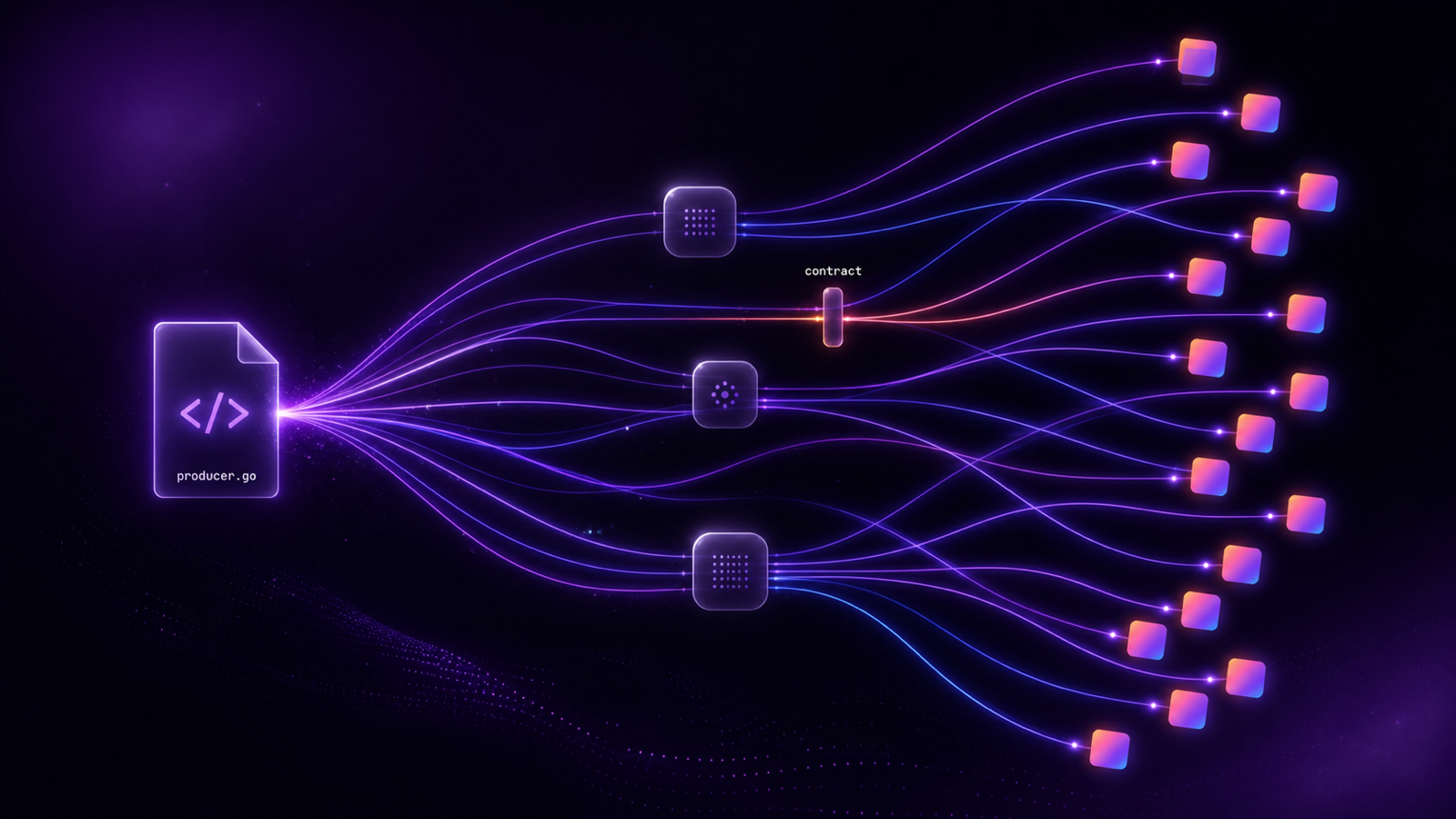
This is where data contracts come in, providing the structure and governance that developers need to secure their LLMs’ data. By establishing these guardrails throughout the model-building process, AI teams can guarantee data quality, lineage, and compliance from the very start, which in turn sets clear expectations about what your model accepts and what it doesn’t.
With these structures in place, engineers can prevent sensitive data from slipping through the cracks, avoid surprises down the line, and keep AI models running at full speed. And with Gable seamlessly automating the tracking and versioning of these data contracts, you’ll be able to make your LLMs secure and resilient from day one.
Ready to embed data quality and governance into your AI models from the get-go? Try out Gable’s demo today to learn how you can start shifting your data governance efforts left.

Gable
April 27, 2026

.avif)
.avif)