.avif)



Ask two data teams to define AI data integrity and there's a good chance the answers describe two different things. One team talks about whether the data is accurate and complete enough to train a useful model. The other talks about whether the data is the same data it started as, unaltered and uncorrupted from the moment it was created to the moment a model learns from it. Both answers sound reasonable. Only the second one is integrity.
That confusion isn't pedantic. It decides where teams look for problems, and it's why so many AI projects ship on data nobody fully trusts. A Qlik survey of 500 U.S. AI professionals found that 81% say their organization still has significant data issues, and 85% believe leadership isn't addressing them. When the definition of the problem is fuzzy, the fixes land in the wrong place: teams scrub records for accuracy while the structural corruption that quietly poisons a model goes unwatched.
AI data integrity is a specific, structural property, and it's worth pinning down precisely, because the way it breaks points directly at where to prevent it.

What is AI data integrity?
AI data integrity is the accuracy, consistency, and trustworthiness of data across its entire lifecycle, from collection and storage through transformation, model training, and inference. It's the assurance that data hasn't been altered, corrupted, or silently changed at any point between creation and use. Integrity is a property of the whole journey, not a snapshot taken once at ingestion.
That lifecycle framing matters more for AI than for traditional analytics. A broken dashboard announces itself: a number looks wrong, someone investigates. A model trained on corrupted data announces nothing. It learns the corruption as if it were signal, bakes it into its weights, and produces outputs that look plausible and are subtly wrong. The CISA, NSA, and FBI joint guidance on AI data security makes the same point at the infrastructure level: the trustworthiness of an AI system's outputs is bounded by the integrity of the data used to build and run it, and integrity has to hold at every stage of the lifecycle for that bound to mean anything.
Integrity failures are also hard to reverse. Once a model has trained on tampered or degraded data, the damage lives in the model, not just the dataset. Catching it after deployment often means retraining from clean data and re-validating everything downstream of the original corruption.
AI data integrity vs. AI data quality
Integrity and quality get used interchangeably, and they aren't the same. The cleanest way to separate them: integrity asks whether the data is structurally sound and unchanged, and quality asks whether the data is fit for the job.
- Data integrity concerns structure and trustworthiness across the lifecycle. Are relationships valid, constraints enforced, records consistent across systems, and the data free from unauthorized or accidental alteration? Integrity underpins compliance, security, and auditability.
- Data quality concerns fitness for use. Is the data accurate, complete, timely, and relevant to the decision or model at hand? Quality supports insight and business value.
They reinforce each other, and a model needs both. Data can pass every structural check and still be unfit: a customer table with valid keys and enforced types can still be full of stale addresses. The reverse holds too. Data can be accurate the moment it's captured and then lose integrity in transit, when a migration silently changes a field's type or a schema change drops a column some downstream job depended on.
Why data integrity is harder to maintain in AI pipelines
AI pipelines are long, and length is the enemy of integrity. Data passes through collection, storage, preprocessing, feature engineering, training, and serving, often crossing multiple teams, tools, and environments along the way. Every handoff is a place the data can change without anyone deciding it should. More stages mean more surface area for corruption, and AI pipelines have more stages than almost anything that came before them.
The failure points cluster into a handful of recurring patterns:
- Input and collection errors, where bad values, wrong timestamps, or duplicated records enter at the source and travel downstream unquestioned.
- Corruption in transfer or storage, where data is altered by a software bug, a network failure, or a database migration that changes structure without warning.
- Labeling errors, where incorrect labels from human annotators or automated processes inject noise and bias into training sets.
- Version mismatches, where a model retrains or evaluates against the wrong dataset version, or test data leaks into training and inflates performance.
- Schema and semantic changes, where an upstream change to a field's type, name, or meaning quietly breaks everything that consumed the old shape.
The threats that matter most
These split into two kinds. Accidental corruption (the migrations, the bugs, the mismatched versions) is the common case, and it's usually a structural problem masquerading as a quality problem. Malicious corruption is the AI-specific threat: data poisoning, where an attacker deliberately alters training data to steer a model's behavior. Poisoning works precisely because integrity checks are weak. If nothing verifies that training data is the data it claims to be, a few corrupted records can change what a model learns, and no accuracy metric will flag it. Both kinds share a root: data changed, and nothing caught the change at the moment it happened.

Where AI data integrity actually breaks: the upstream blind spot
Most integrity programs bolt verification onto a pipeline that's already running. Checksums at rest, audits on a schedule, monitoring on the warehouse, access controls on the store. All of it useful, all of it downstream of where integrity is actually decided.
The most common source of silent corruption is an upstream change in application code. A software engineer renames a field, changes its type, alters what a value means, or drops a column. They ship a routine code change with no visibility into the fact that the field feeds a feature in a model three systems away. The change is correct in the context the engineer can see. It's catastrophic in a context they can't. This is the same dynamic behind most data anomalies: schema changes made without coordination between data producers and consumers are one of the most significant structural causes of corruption in modern data environments, and they propagate through interconnected pipelines until a localized change becomes a system-wide problem.
Monitoring catches this after the model has already learned from the bad data. Lineage tools help trace the blast radius once something breaks. Audits surface it at the next review. Every one of those controls operates after the change has shipped and the corruption has spread. The leverage point sits earlier, at the moment the change is written, before it merges into the codebase that produces the data. Integrity is decided where data is created, and that's upstream of every place most teams are looking.
How to keep AI training data clean at the source
Keeping training data clean means moving integrity checks toward the point of data creation rather than concentrating them at ingestion or in the warehouse. A practical progression:
- Validate at the point of creation, not just at ingestion. By the time data reaches the warehouse, a structural change has already propagated. Checks that run where data is produced catch corruption before it travels.
- Make producer-consumer expectations explicit. Most silent corruption traces back to an expectation that was never written down: a producer didn't know a field was load-bearing for someone downstream. Defining schema, semantics, and ownership turns an implicit assumption into a stated agreement.
- Enforce those expectations in CI/CD. An agreement nobody enforces is documentation. Checking changes against the agreement inside the pipeline that ships code means a breaking schema change is caught before it merges, not after it corrupts a training run.
- Version datasets and keep an audit trail. Dataset and contract versioning, with a record of every transformation, makes corruption traceable and retraining reproducible when something does slip through.
- Keep the downstream controls. Checksums, access controls, and integrity audits still matter, especially against tampering and storage corruption. They're necessary. They're just not sufficient on their own, because they sit downstream of the most common failure.
The pattern across all of these is the same: catch the change at the source instead of detecting its damage downstream. That's also the principle behind data governance that's proactive rather than reactive, and it's what code-level lineage makes possible by mapping how a given field propagates across services before a change to it ships.
Integrity starts where data is created
AI data integrity isn't a monitoring problem or a cleanup problem. It's a question of whether the data a model learns from is the data it was supposed to learn from, and that question is answered upstream, at the point a producer's code creates or changes the data. Every control that runs later is working with corruption that has already happened.
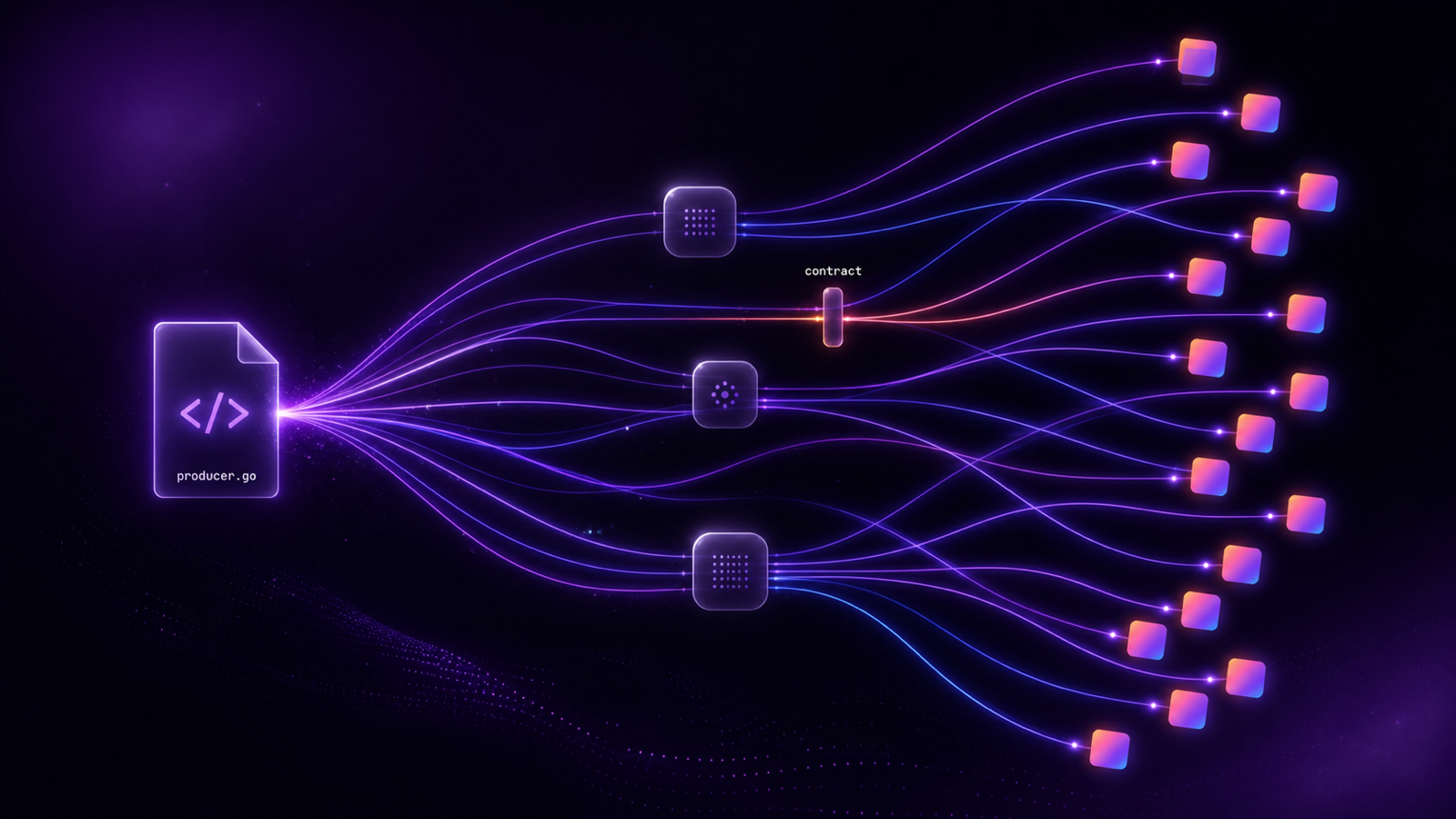
This is what data contracts address directly. A data contract defines the schema, semantics, and ownership a producer and consumer agree on, and enforceable constraints turn that agreement into automated checks that run in CI. A breaking change gets flagged before it merges, so the data feeding a model stays structurally intact from the moment it's created. Integrity stops being something teams verify after the fact and becomes something the pipeline holds by default.
For teams whose AI initiatives depend on data they can actually trust, that shift toward the source is where integrity becomes durable. Explore how data contracts keep training data clean from the point of creation with Gable.

Gable
July 1, 2026

.avif)
.avif)