%20(1).avif)



A recommendation model that performed well for months starts quietly drifting. Conversions slip, the predictions skew, and no alert fires because nothing technically broke. After three days of tracing the problem through transformation layers, the team finds the cause: a producer renamed a field and dropped a column in an upstream service, and that change flowed straight into the feature pipeline. The model had been training on bad data the whole time, and no one knew where the data came from until it was too late.

That scenario is the reason AI data lineage has become a priority for data teams. As organizations push more data into training pipelines and inference systems, knowing where that data originates, how it's transformed, and which models depend on it stops being a nice-to-have and becomes the foundation of trustworthy AI. The numbers reflect the pressure: 62% of organizations believe a lack of data governance is the main data challenge holding back their AI initiatives, according to a Drexel University and Precisely study. Lineage sits at the center of that challenge.
What AI data lineage actually means
Data lineage is the record of where data originates, how it moves and changes as it travels through systems, and where it ends up. Data lineage for analytics and BI has been a discipline for years. AI data lineage applies the same idea to the data that feeds machine learning: the training datasets, the features derived from them, and the inputs that flow into a model at inference time.
The term gets used two ways, and they're worth separating. One sense is lineage for AI systems, which means tracking the data that trains and runs models. The other is AI-generated lineage, where machine learning infers data flows automatically from query logs and metadata. This guide focuses on the first sense, because that's where the risk to AI outcomes lives.
AI raises the stakes well beyond traditional reporting lineage for three reasons. Models absorb bad inputs silently, with no error to flag the problem. Their outputs are opaque, so a wrong prediction rarely points back to its cause. And the blast radius is wide, since a single corrupted feature can skew every decision a model makes until someone catches it.
Why AI systems make lineage harder than traditional pipelines
AI workloads break several assumptions that older lineage practices relied on. Three differences cause the most trouble.
First, training data comes from everywhere. Teams pull from internal warehouses, event streams, and third-party datasets, often stitching sources together quickly to meet a model deadline. Governance frequently isn't looped in, which means sensitive fields and unvetted sources enter the pipeline without anyone recording how they got there. Strong data governance for AI depends on knowing those origins, and ad hoc sourcing erodes that visibility fast.
Second, models are black boxes. Many of the most capable systems, including large language models, are opaque even to their creators, so users can see the inputs and outputs but not how one produced the other. IBM describes a black box AI as a system whose internal workings stay hidden from the people using it. When the model itself can't explain a decision, lineage becomes the only reliable way to reason about what data shaped that decision.
Third, degradation is silent. Model drift and quiet schema changes erode performance without throwing errors. A field that shifts type, a unit that changes, or a source that goes stale will keep flowing into the model, and the metrics decay gradually enough that no monitor trips. By the time someone investigates, the lineage trail is the only path back to the cause.

The four things AI data lineage needs to capture
Useful AI data lineage tracks more than a diagram of arrows between tables. To support trustworthy AI, it needs to capture four things about every dataset that touches a model.
Source and provenance
Where each dataset originated, who owns it, and what sensitivity or lawful-basis tags apply. Provenance answers the first question anyone asks after a bad prediction: where did this data come from, and can the team trust it?
Transformations
Every step between a raw source and a model input. This includes joins, aggregations, filtering logic, and unit conversions, plus the points where personally identifiable information enters the pipeline or should have been stripped out. Transformations are where data quietly changes meaning, so they're the steps most worth recording.
Downstream consumers
Which models, features, and decisions depend on a given dataset. This is the view that makes impact analysis possible: before changing a source or a transformation, a team can see exactly which models would feel the change. Without it, every upstream edit is a gamble.
Ownership and accountability
Who's responsible when a field changes. Most lineage tools map the technical flow well but leave ownership implicit, so when a schema changes and a model breaks, no one's clearly accountable for the agreement that was violated. Ownership is the beat that turns a lineage graph into something a team can act on, and it's the bridge to a more durable approach.
Where downstream lineage falls short for AI
Most lineage tools build their picture by observing data after it moves. They scan query logs, warehouse metadata, and BI definitions, then reconstruct the flow from those observations. That approach has a structural weakness: the lineage graph always lags the change that caused the problem.
When a producer ships a breaking schema change, the data starts flowing immediately. The lineage graph only reflects the new reality once the tool re-scans and reconciles its sources. By the time the graph shows the broken edge, the bad data has already trained the model or fed an inference. Reconstructed lineage is excellent for forensics, telling a team what already happened, but it can't prevent the incident it's documenting.
The reconciliation problem makes this worse. Lineage assembled from many systems often conflicts, because the BI tool reports one set of dependencies, the transformation layer reports another, and the warehouse logs something different. Teams then spend effort deciding which version to trust. That conflict is a symptom of capturing lineage too late and too far downstream, after the data has already fanned out across tools. The same root cause drives most data quality failures in AI pipelines: the truth about the data was never recorded where the data was created.
Shifting lineage left: provenance defined at the source
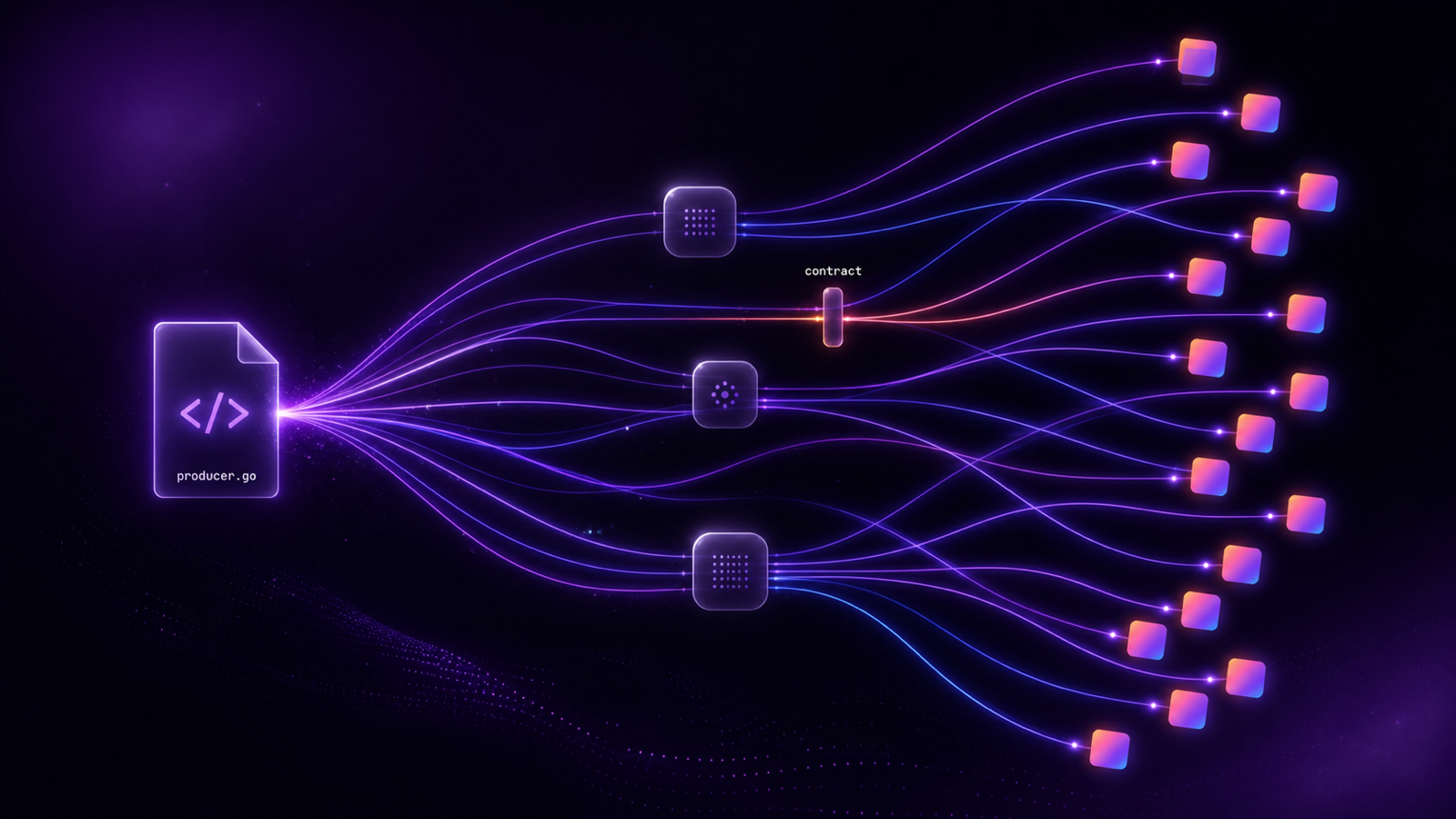
There's an alternative to reconstructing lineage after the fact: declare it at the point of creation. That's the idea behind shift-left data and data contracts. A data contract is a version-controlled agreement that captures the structure, semantics, operational expectations, and governance rules of a dataset right where the data is produced, in source code and CI/CD pipelines.
That changes what lineage is. Instead of a map a tool reconstructs by watching data flow, provenance and ownership become explicit at the moment of data creation. The contract states who owns the dataset, what its schema is, and what consumers can expect, and it lives alongside the code that produces the data. Lineage is declared, not inferred.
Enforcement is what makes the declaration matter. When a contract is in place, schema or meaning drifts are caught during pull-request checks rather than in production dashboards. A breaking change fails the check at the pull request instead of surfacing as a degraded model weeks later. Gable implements this at the application code level, so the producer learns their change would break a downstream contract before the change ever merges. Data change management shifts from reactive cleanup to a gate that runs at the source.
For AI specifically, that's the difference that counts. The data feeding training and inference becomes data that was agreed on and validated before it propagated. When a model consumes a feature, the contract guarantees the feature still matches the shape and meaning the model was built around. Provenance isn't a record assembled after an incident; it's a property the data carries from the start.
How to start building AI data lineage that holds up
Building lineage that supports AI doesn't require ripping out existing tooling. It works as a sequence, starting with visibility and moving toward enforcement.
- Inventory the AI data sources. List every dataset that feeds a model, including third-party and ad hoc sources that bypassed governance.
- Map the current flows. Trace how each source reaches a model, and document the transformations and the PII touchpoints along the way.
- Tag sensitive fields and assign ownership. Make provenance and accountability explicit for the datasets that carry the most risk.
- Push enforcement upstream. For new sources, require declared contracts so lineage arrives with the data rather than getting reconstructed afterward.
The first three steps strengthen the lineage a catalog or observability tool already provides. The fourth is the shift-left move that keeps the graph accurate over time, because new data arrives with its provenance and ownership already declared. Treating data as a product, with clear owners and contracts, makes that durable rather than a one-time cleanup.
From tracing problems to preventing them
Lineage reconstructed downstream tells a team what already broke. It's valuable for forensics, but it arrives after the bad data has reached the model. Provenance declared upstream, in data contracts enforced at the source, keeps the broken change out of the model in the first place. For AI systems, where bad inputs degrade outputs silently and the cause is hard to trace through an opaque model, that shift from documenting incidents to preventing them is what separates AI a team can trust from AI that creates risk with every decision.
Teams rethinking how they track the data behind their models can explore how data contracts make provenance and ownership explicit at the point of creation. Sign up with Gable to see how that works in practice.

Gable
July 1, 2026

.avif)
.avif)