.avif)



Agentic data management hands the repetitive, judgment-heavy work of running a data estate to AI agents that plan, decide, and act on their own. An agent watches incoming feeds and resolves duplicate records as they appear. It reroutes a pipeline when a source stalls. It enforces a policy the moment data crosses a boundary. No ticket, no queue, no waiting for a human to notice. For data teams buried under more pipelines than they can staff, that kind of speed and scale is the whole appeal.
Speed is the whole point. It's also where the real question lives. An agent acting in seconds on a bad input doesn't slow down to second-guess it. It commits the wrong decision faster than any human would, and then propagates that decision across every downstream system that trusts it. Autonomy multiplies whatever it's given. Point it at correct, well-defined data and it compounds good decisions. Point it at an unvalidated upstream change and it compounds the damage just as efficiently.
That tension sits at the center of agentic data management. The technology delivers on its promise only when the data underneath the agents is trustworthy at the point it's created. This guide covers what agentic data management is, why it's gaining ground now, the risk that autonomy quietly raises, and what data teams need in place before handing agents the keys.

What is agentic data management?
Agentic data management is an approach where AI agents autonomously plan, decide on, and execute data lifecycle tasks, with people setting the intended outcomes and stepping in by exception. Instead of an engineer scripting each transformation or hand-running a quality check, the agent interprets a goal, works out the steps, and carries them out across ingestion, integration, quality validation, governance enforcement, and workload optimization.
This differs from the automation data teams already run. Rule-based automation follows fixed logic: when X happens, do Y. It does exactly what it was told and nothing more. An agent interprets intent and adapts as conditions change, drawing on metadata, data lineage, and business rules to decide what data is relevant and how to handle it. According to IBM, what sets agentic data management apart from traditional approaches is that it's self-adaptive, adjusting its plan as the environment shifts rather than treating a workflow as a fixed artifact.
Across vendor definitions, a few components recur. Large language models supply the reasoning layer that interprets a request and translates it into a plan. Specialized agents handle distinct stages of the lifecycle and coordinate as a multi-agent system. And metadata serves as the shared context that tells agents what data exists, where it came from, and what depends on it. Hold onto that last one. It matters more than it first appears.
Why agentic data management is gaining attention now
The interest isn't hype for its own sake. Three pressures have been building for years, and agentic approaches speak directly to all three.
The first is volume and fragmentation. Data estates now span dozens of systems, hundreds of pipelines, and thousands of assets across hybrid and multicloud architectures. Manual processes and rule-based scripts can't keep pace when sources and APIs change daily, and the dependency chains between them grow harder to hold in any one person's head.
The second is the cost of unreliable data. When data is hard to reach or hard to trust, decisions get made without it. In a 2025 survey of 536 data professionals, Sisense found that 76% of organizations admit to making business decisions without consulting available data because it was too difficult to access. That's the gap agentic systems promise to close, by making trustworthy data move on its own.
The third is capacity. Demand for data work outstrips the headcount to do it, and centralized teams dependent on manual integration become the bottleneck for everyone downstream. Agents offer a way to scale the work without scaling the team in lockstep.
The appeal is real, and worth taking seriously on its own terms. The open question isn't whether agents can do the work. It's what has to be true underneath them for the work to be trustworthy.

The risk hiding inside autonomous data work
An agent is only as reliable as the data and the definitions it operates on. That sounds obvious, but autonomy changes the stakes in a way that's easy to underrate. A human analyst who sees a number that looks off pauses and asks around. An agent optimizing for the outcome it was given acts on what it receives, immediately, and at machine speed. The judgment that used to sit between a bad input and a bad decision is exactly the thing autonomy removes.
Upstream schema changes are the classic trigger. A software engineer renames a field, changes a data type, or drops a column to ship a product feature, with no idea that a downstream pipeline depends on the old structure. The change is silent. An agent consuming that data reasons over the new shape as if it were correct, and confidently produces an output that's wrong. The same schema changes that have always caused data quality incidents don't disappear under agentic management. They get acted on faster.
This reframes the one thing the industry agrees on. Metadata is widely described as the foundation for agents, because agents need shared ground truth to coordinate, and the common diagnosis is that agent failures trace back to fragmented metadata and missing context. That's correct as far as it goes. But a catalog describes what data is. It doesn't enforce what data should be. Knowing the shape of a dataset doesn't prevent a producer from changing that shape tomorrow without warning. Context tells an agent what it's looking at. It doesn't guarantee what it's looking at is right.
Agents are now data producers too
There's a second wrinkle the downstream framing misses entirely. Agents don't only consume data. They generate and transform it, then write those outputs back into pipelines that other systems, and other agents, depend on.
An agent that merges records, imputes missing values, enriches a dataset, or generates a new table is a data producer, every bit as much as a software engineer committing a schema change. When that output flows downstream with no agreement governing its shape or meaning, it becomes a new source of exactly the problems agentic management was supposed to solve, now moving at machine speed and multiplying as more agents come online. Autonomous producers without enforced expectations are how a fast system quietly corrupts itself.
How data contracts make agentic data management trustworthy
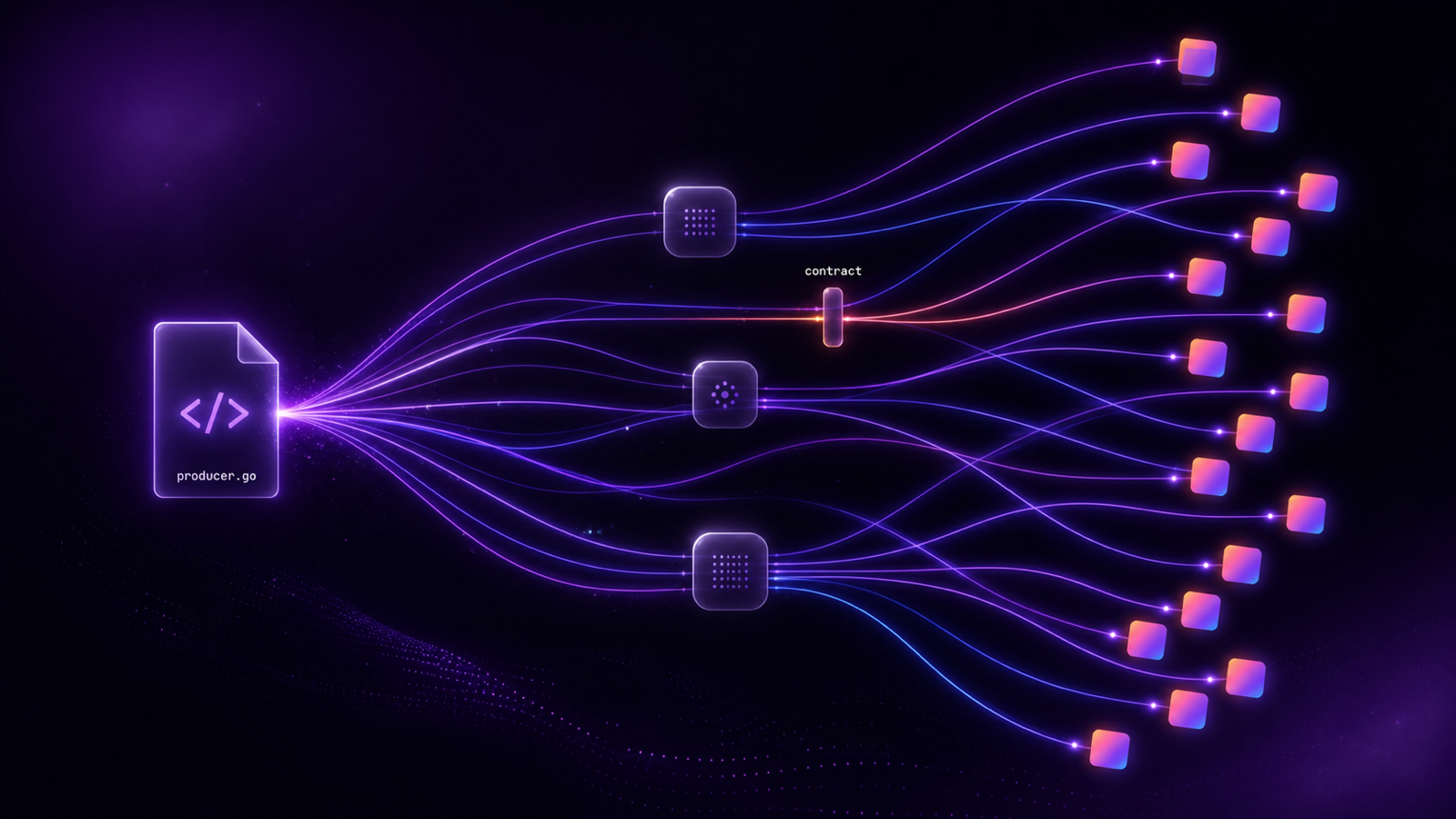
If the constraint is trust at the point data is created, the fix has to live there too. This is the core idea behind shift-left data: move quality, ownership, and governance upstream, to the moment data is produced, instead of inspecting for problems after they've already spread. Data contracts are how that idea becomes enforceable.
A data contract is an agreement between data producers and consumers that defines a dataset's schema, semantics, and ownership, and is enforced in CI/CD before a change ships. When a producer tries to alter data in a way that would break the contract, the check fails at the pull request, not three systems downstream after an agent has already acted on it. For a concrete walkthrough of what one looks like, see this data contract example. The effect is to make the definition of correct explicit, owned, and validated at the source.
That foundation changes what autonomy means in practice, on both sides of the agent.
For agents consuming data, contracts guarantee the inputs are valid before the agent ever reasons over them. An upstream change that would have fed the agent a bad input gets caught at the producer's commit instead, for any source whose changes flow through a gated pipeline. Autonomy then compounds correct decisions, because the data underneath it holds.
For agents producing data, contracts bring agent outputs under the same enforced expectations as any other producer. An agent can't silently push a malformed table or a redefined field into a shared pipeline, because the contract validates its output the way it validates a human's. The producer being a model rather than a person changes nothing about the guarantee.
This is the producer-side foundation that the downstream-automation framing leaves out. Treating governance as code, enforced at the source, rather than as monitoring bolted on after the fact, is what lets agents operate at speed without that speed becoming a liability.
Putting agentic data management into practice
For data teams weighing where to start, a handful of vendor-neutral moves set agentic work up to succeed rather than backfire.
- Establish shared metadata and lineage context. Agents need to understand dependencies, sensitivity, and how data flows before they can act responsibly. This is the groundwork the rest depends on.
- Define and enforce data contracts at producer boundaries before scaling agent autonomy. Validated inputs and outputs are what make autonomous decisions safe to trust.
- Start with bounded, high-value workflows. A compliance-heavy ingestion path or an uptime-critical pipeline gives agents a clear scope and a measurable outcome, with humans overseeing by exception.
- Treat agent-generated data as a governed producer from day one. Bring agent outputs under contract enforcement the same way producer commits are, so autonomy doesn't open an ungoverned back door.
Done in that order, autonomy scales on a foundation that holds. Skipped, it scales on sand. For teams formalizing how changes move through their systems, data change management practices reinforce the same principle: agree on expectations before the change lands, not after it breaks something.
Trustworthy autonomy starts at the source
Agentic data management's promise is genuine. Agents that plan, decide, and act on their own can lift an enormous load off data teams and make trustworthy data move at the speed the business now expects. But speed and scale are assets only when the data underneath is correct. Hand an agent unvalidated data and autonomy becomes a faster path to the wrong answer, whether the agent is consuming that data or generating it.
Data contracts supply the foundation that makes autonomy safe, by defining and enforcing what correct data looks like at the moment it's produced. That's what shift-left data makes possible, and it's the difference between agents that compound trust and agents that compound risk. To go deeper on the thinking behind it, read the Shift Left Data Manifesto from Gable co-founder Chad Sanderson, then explore how Gable enforces data contracts in the pipeline by signing up at Gable.ai.

Gable
June 26, 2026

.avif)
.avif)